
Reducing the lag from observation to action
Quentin Groom · Monday plenary programme
The short versionTimeliness is a missing biodiversity knowledge shortfall: publish soon, publish often, and improve continuously.
What this was about
Quentin Groom looked at the delay between a biodiversity observation and the moment someone can act on it, with a focus on early detection of invasive species. He showed that recent GBIF monthly observation counts drop because data has not yet been mobilised, and used iNaturalist data to show that identifications can take months to become stable. He separated unavoidable lags from operational choices such as embargoes, unconnected systems and waiting for a dataset to be 'finished'. He then proposed a new 'Wangari Maathai shortfall' for timeliness, to add to the known biodiversity knowledge shortfalls. Q&A covered publishing data directly instead of through papers, and data valuation mechanisms.
Why it matters. For invasive species, pests and conservation action, data that arrives years late loses much of its value. As automated sensors take over from human observers, alert systems are needed so that unexpected species are noticed at all.
In the room
- GBIF monthly observation counts fall off over the last two years because observations have not been mobilised yet, not because people stopped observing. The lag goes back further and covers tens of millions of records.
- For invasive species, delays let a species establish and spread, raising the cost of eradication until it is no longer feasible.
- Informal networks (emailing someone you know) work locally but do not scale.
- Within about five years, data from eDNA, camera traps, acoustic sensors and automated imaging may outnumber human observations. Without a human in the loop, invasive species that are not specifically looked for will go unseen.
- Lag builds up across observation, identification, digitisation, standardisation, validation, publication, aggregation, analysis, alerting and action.
- In iNaturalist, bird identifications are right on day one about 50% of the time, but plants only about 10%. Identifications can take months to years to stabilise.
- Some lags are real difficulties (remote fieldwork, taxonomic uncertainty). Others are operational choices (embargoes, unconnected systems, waiting for a dataset to be finished).
Notable moments
Transcript
Automatically generated captions can contain mistakes, especially in names and technical terms. Times are relative to the room recording.
Read the transcript ↓
Related talks.
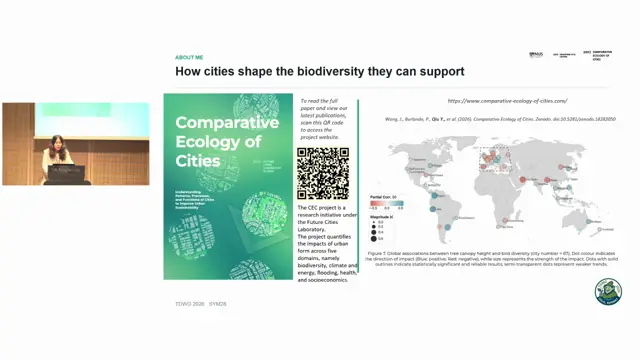
Reporting structure and sampling-bias correction in citizen-science bird data across Asian cities
Abundant citizen-science records do not guarantee inference support; reporting structure can distort richness hotspots and urban-biodiversity relationships unless it is diagnosed and controlled.
From Sensor to Species: AI-Assisted Segmentation, Deep Learning Workflows, and Persistent Biodiversity Records from Earth Observation Systems
Persistent organism identifiers for remotely sensed individual trees could turn repeat Earth-observation imagery into longitudinal biodiversity records, but only if uncertainty and model provenance travel with every record.
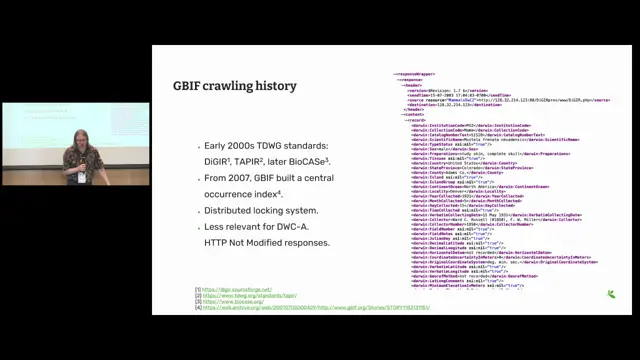
The GBIF data index: crawling and crawled
AI-era crawling through residential proxies is a new, hard-to-block load that is forcing open biodiversity infrastructures and their publishers to spend effort on defence.