
AI Ready Standards with Croissant for Type Specimens Catalog Datasets
Sefika Efeoglu · AI-Readiness Metrics and Metadata for Biodiversity Data
The short versionCombining LLM extraction, Darwin Core and Croissant metadata offers a route from historical specimen catalogues to FAIR, ML-ready datasets.
What this was about
Sefika Efeoglu presented a workflow for turning historical type specimen catalogues into AI-ready datasets: LLMs (e.g. GPT and Qwen) extract structured information from unstructured catalogue text, which is expressed in Darwin Core and then described with ML Commons Croissant metadata in JSON-LD. She showed how Darwin Core fields map to Croissant fields (scientific name as label, genus as taxonomic feature, individual count as integer, catalogue number as identifier, locality, event date, collector, type status) and how the pipeline evaluates FAIR metrics. The approach aims to bridge biodiversity standards and ML dataset platforms such as Hugging Face, Kaggle and OpenML.
Why it matters. Croissant is becoming the metadata layer ML platforms understand; mapping Darwin Core into it could make collection data directly discoverable and loadable in ML ecosystems.
In the room
- Biodiversity data are used for species identification, named entity recognition, taxonomic knowledge extraction and knowledge graphs, but historical catalogues are largely unstructured text.
- FAIRness supports ML reproducibility, clarity, sharing and more reliable model development; the aim is to extend FAIR into ML workflows.
- Croissant (ML Commons) is a standardised, machine-readable metadata format for ML-ready datasets supported by platforms such as Hugging Face, Kaggle and OpenML: 'create once, publish anywhere, use everywhere'.
- Workflow: type specimen catalogue, unstructured text, LLM-assisted extraction (GPT, Qwen), Darwin Core metadata, Croissant metadata, AI-ready dataset.
- Mapping examples: scientificName as label for classification, genus as taxonomic feature, individualCount as integer feature, catalogNumber as unique identifier, locality, eventDate, collector (provenance) and typeStatus.
- Records are represented in Croissant JSON-LD with explicit field data types; the pipeline measures FAIR metrics and metadata quality.
Notable moments
Transcript
Automatically generated captions can contain mistakes, especially in names and technical terms. Times are relative to the room recording.
Read the transcript ↓
Related talks.
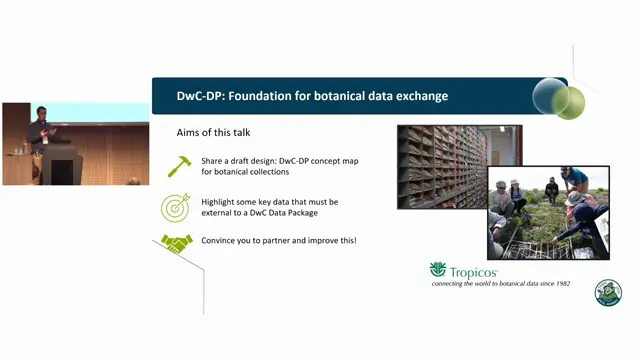
Machine-Ready Botanical Data: Mapping Integrated Collections and Traits with Darwin Core Data Package
Darwin Core Data Package can serve as a semantic integration layer for a botanical garden's diverse collections and trait data, and MBG's draft mapping is offered for community refinement.
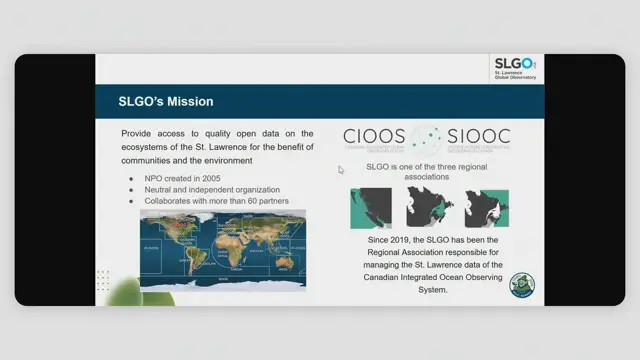
Extracting Structured Biodiversity Knowledge from Literature with AI-Assisted Workflows
A hybrid text-layer/OCR tool can free tables from grey-literature PDFs into CSV with about 83% precision, but it misses a third of tables, especially narrow ones.
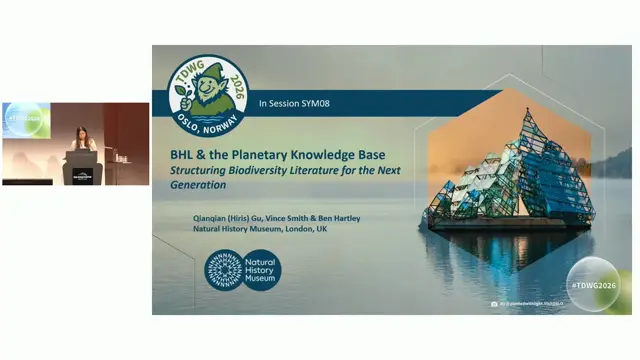
BHL and the Planetary Knowledge Base: Structuring Biodiversity Literature for the Next Generation
NHM is re-OCRing all of BHL with modern models and extracting entities into a knowledge graph, with confidence gating to protect BHL data quality.