
Digitising heritage for science: the Medical Entomology Museum as a platform for entomological biodiversity research and vector-borne disease surveillance
Eunice Jamesboy · Digitizing Collections & Legacy Data
The short versionDigitised historical mosquito vouchers become reusable evidence that gives context to current vector surveillance.
What this was about
Eunice Jamesboy presented the century-old Medical Entomology Museum at South Africa's National Institute for Communicable Diseases, rooted in the 1925 entomology department's response to malaria. The museum holds about 60,000 medically important insect specimens, including about 12,000 Anopheles, and about 80% of the mosquito collection is digitised through a workflow of inventory, transcription, taxonomic standardisation, georeferencing and quality control aimed at FAIR, interoperable data. She argued that digitised vouchers provide historical baselines that strengthen contemporary vector surveillance, stressed rescue of orphaned collections and training, and summarised the approach as 'preserve the specimen, mobilize the data, extend science'.
Why it matters. Shows a direct public-health use case for natural history collection digitisation in malaria-affected regions.
In the room
- The Department of Entomology was established in 1925; early mosquito surveys in malaria areas generated the core collection.
- About 60,000 specimens including around 12,000 Anopheles; pinned, slide-mounted and fluid specimens, type material and vouchers.
- About 80% of the mosquito collection, including Anopheles, is digitised.
- Workflow: inventory/accessioning, label transcription, taxonomic standardisation, georeferencing, QC, publication.
- Museum data do not replace contemporary surveillance but provide historical context and verifiable vouchers.
- Orphaned collections need condition assessment, accessioning, metadata recovery and integration.
- Sustainability depends on training people in taxonomy, curation, georeferencing and informatics.
Notable moments
Transcript
Automatically generated captions can contain mistakes, especially in names and technical terms. Times are relative to the room recording.
Read the transcript ↓
Related talks.
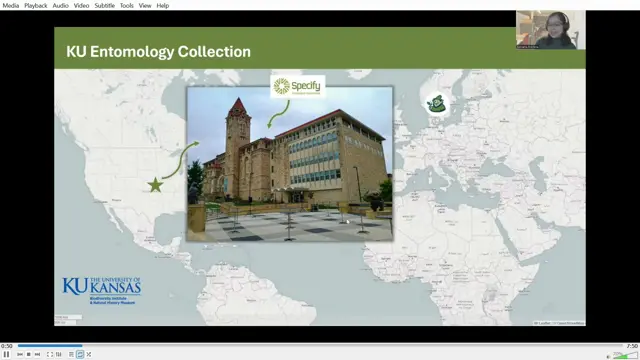
Updates on Data Mobilization in the KU Entomology Collection
Moving to Specify 7 with a nightly Darwin Core archive feed made KU Entomology's data and images continuously available to GBIF, Symbiota portals and students.
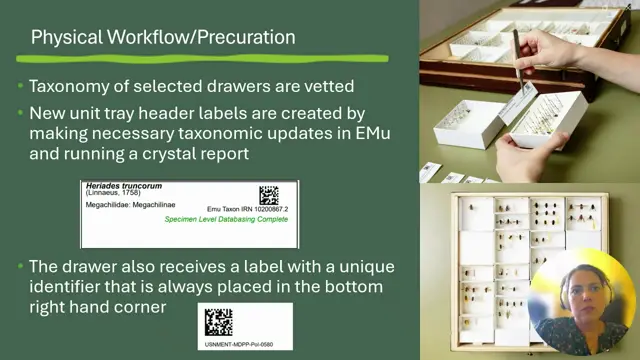
Pinned insect digitization conveyor: image and data transcription workflows
An industrial conveyor workflow with QR-encoded metadata and automated skeletal records makes mass digitisation of pinned insects feasible.
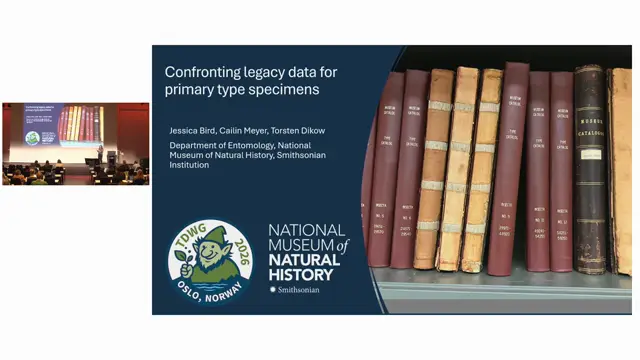
Confronting legacy data for primary type specimens
Decades of database migrations left the second-largest insect collection's type catalogue unreliable, and only a full physical inventory is fixing it.