
Explore the conversation.
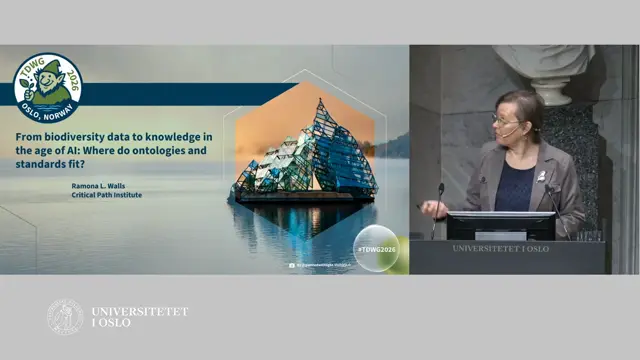
From biodiversity data to knowledge in the age of AI: where do ontologies and standards fit?
AI can generate data and candidate knowledge, but only standards, ontologies, provenance and governance let data become trusted evidence and therefore knowledge, which is why TDWG matters more than ever.
Ramona Walls ↗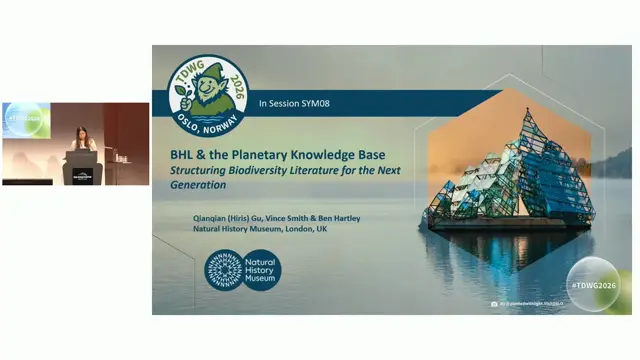
BHL and the Planetary Knowledge Base: Structuring Biodiversity Literature for the Next Generation
NHM is re-OCRing all of BHL with modern models and extracting entities into a knowledge graph, with confidence gating to protect BHL data quality.
Qianqian Hiris Gu ↗
Biological occurrence data from historic scientific correspondence: enabling automated approaches for structured data extraction from body text
A Darwin Core-aligned annotated corpus from MfN journals provides a reference for evaluating automated occurrence extraction from historical texts.
Christian Bölling ↗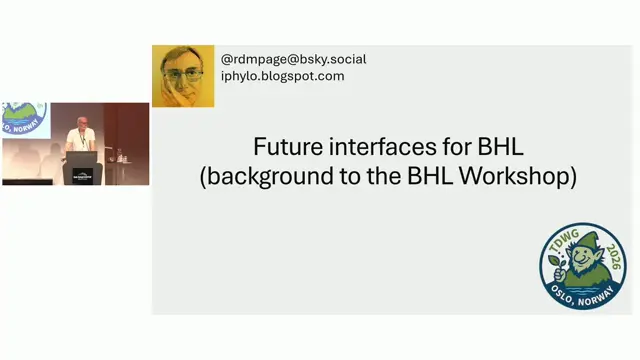
Future interfaces for BHL
Modern AI tools make new BHL interfaces feasible now (better OCR, image and map search, chatbots); the community must decide which are worth building.
Roderic Page ↗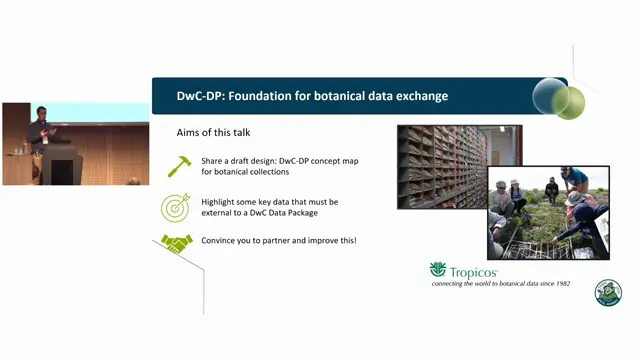
Machine-Ready Botanical Data: Mapping Integrated Collections and Traits with Darwin Core Data Package
Darwin Core Data Package can serve as a semantic integration layer for a botanical garden's diverse collections and trait data, and MBG's draft mapping is offered for community refinement.
Nathan VanderKraats ↗
Multimodality for Knowledge Extraction from Historical Entomology Literature
Aligning text and illustrations in a multimodal knowledge graph can generate evidence-grounded captions and recover knowledge lost by text-only extraction.
Jana Hoffmann, Sefika Efeoglu ↗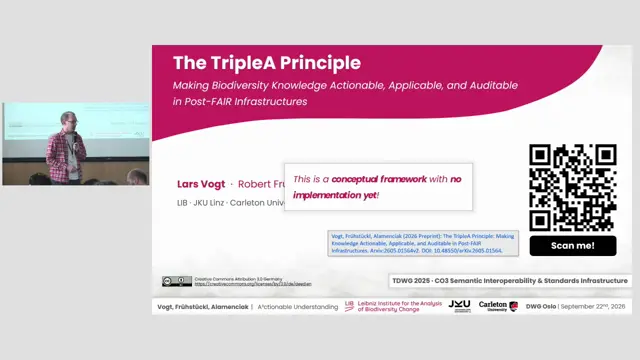
The Triple A Principle: actionability, applicability and auditability for actionable biodiversity knowledge
Actionable biodiversity knowledge needs procedural content with explicit applicability conditions and evidence, not just FAIR metadata.
Lars Vogt ↗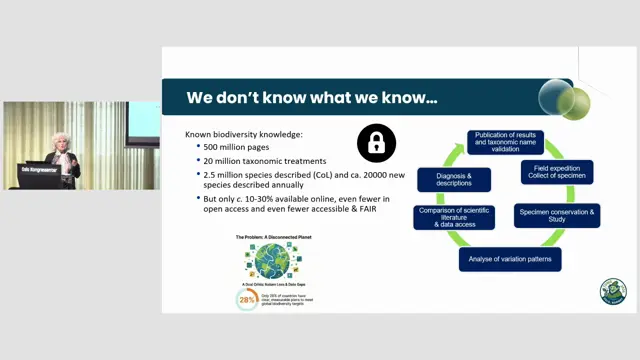
Building digital-native species: Transitioning from PDF liberation to semantic-by-design publishing
Keeping data linked and structured from specimen to publication yields FAIR, trusted data on the day of publication.
Laurence ↗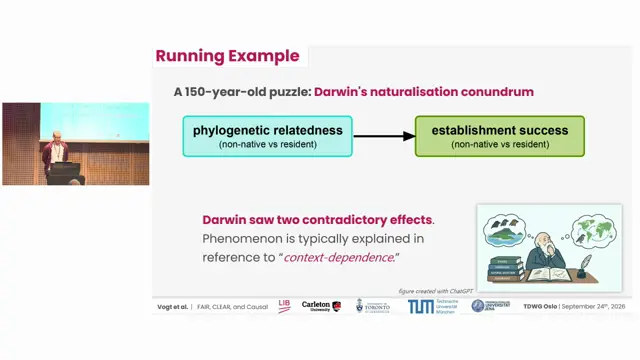
FAIR, CLEAR, and Causal: A semantic framework for ecological knowledge synthesis
Semantic Units can turn ecological causal claims into addressable, versioned graph objects to which evidence and failures can be pinned, helping ecology accumulate rather than merely accrue causal knowledge.
Lars Vogt ↗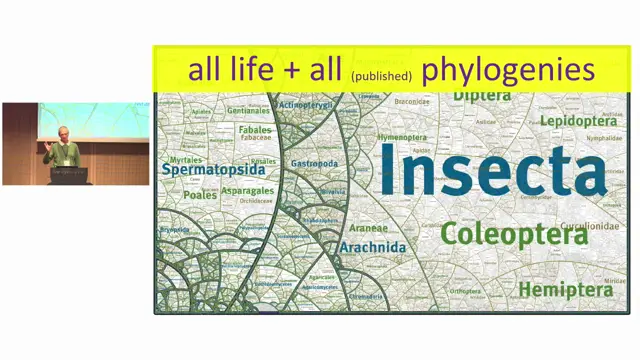
LifeGate: Extending a Global Visual PhyloMap into a Structured Biodiversity Knowledge System
LifeGate's visual map of all described species will become an open, connected knowledge system with trait-based faceted search built from AI-assisted literature extraction.
Martin Freiberg, Birgitta König-Ries ↗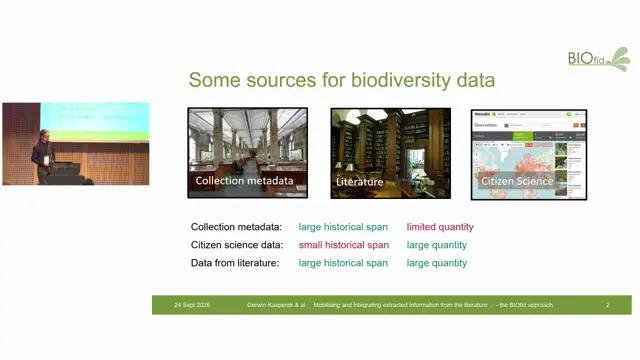
Mobilising and integrating extracted information from the literature into a biodiversity data ecosystem - the BIOfid approach
BIOfid mobilises Central European biodiversity literature with NLP, ontologies and standards, because raw LLM extraction still hallucinates identifiers and needs verification.
Gerwin Kasperek ↗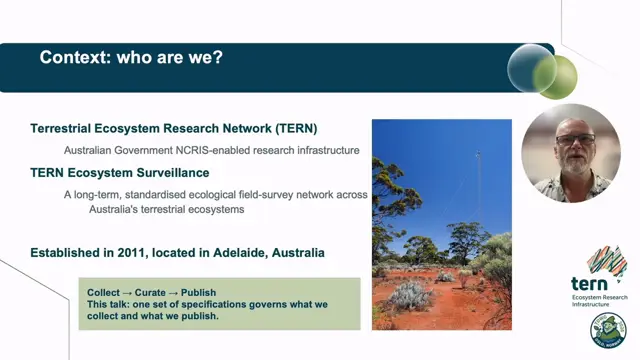
Robot-ready by construction: an ontology-driven, SHACL-validated submission pipeline for national ecological monitoring data
Driving both field data capture and RDF export from one semantically annotated specification makes monitoring data standards-compliant and machine-ready from the start.
Andrew Tokmakoff ↗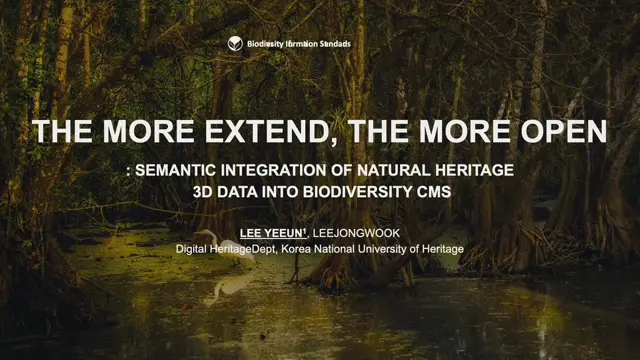
The More Extended, The More Open: Semantic Integration of 3D Natural Heritage Data into Biodiversity CMS
Treating 3D specimen models as entry points in a knowledge graph that includes heritage context and digitisation paradata makes them reusable knowledge assets.
Yeeun Lee ↗
Curation through citation: using AI and a knowledge graph to curate DNA barcodes
Linking barcodes, specimens and literature in a knowledge graph could fix many BOLD records, if we can reliably extract the connecting codes from papers.
Roderic Page ↗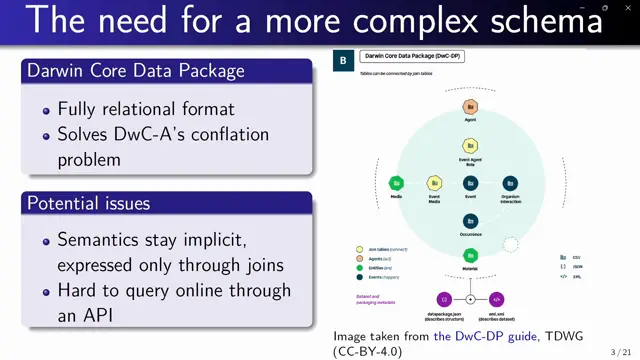
Enabling machine-readable access to biodiversity data through federated semantic querying
Distribute the data, not the infrastructure: cloud Parquet plus OBDA query rewriting gives a virtual Darwin Core knowledge graph without duplicating data into RDF.
El-Amine Mimouni ↗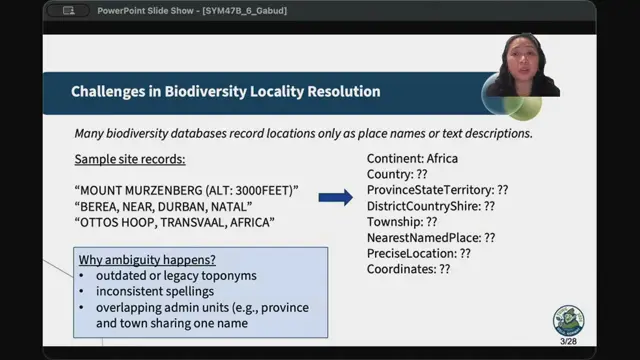
Enhancing Biodiversity Georeferencing Using Large Language Models and Knowledge Graphs
LLM preprocessing plus knowledge-base matching fills in locality hierarchies and proposes coordinates, with a review tool to keep humans in control.
Roselyn Gabud ↗
Prototype: The Semantic Units Framework and Rosetta Statements for Knowledge Graph Construction Workflows
Rosetta-statement templates compiled into RML and SHACL make semantic-unit knowledge graphs much easier to author, at the cost of larger graphs.
Tarek Al Mustafa ↗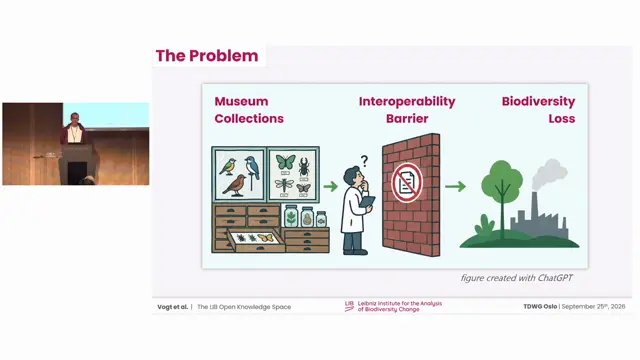
The LIB Open Knowledge Space: A semantic architecture for FAIR, CLEAR, and AI-ready biodiversity knowledge
Knowledge can enter the LIB Open Knowledge Space as natural language immediately and be formalised step by step, so content becomes FAIR, CLEAR and AI-ready incrementally.
Lars Vogt ↗
The Planetary Knowledge Base: an infinite solutions engine converting data into action for nature
The NHM is building the Planetary Knowledge Base in phases, with provenance, attribution and benefit-sharing designed in, to move biodiversity data to evidence to action at scale.
Vincent Smith ↗
Using Large Language Models to enhance biodiversity knowledge extraction: From taxonomic treatments to graph-based knowledge systems
Taxonomic treatments hold underused habitat knowledge that LLMs and a provenance-preserving knowledge graph can structure and link to ecoregions, helping map data-poor species.
Ian Ondo ↗