
Future interfaces for BHL
Roderic Page · BHL at 20: A New Chapter for Biodiversity Literature and Data - Transforming BHL: Data Extraction, Semantic Navigation and Future Interfaces
The short versionModern AI tools make new BHL interfaces feasible now (better OCR, image and map search, chatbots); the community must decide which are worth building.
What this was about
Rod Page previewed live demos for Thursday's BHL interfaces workshop, emphasising he could not promise BHL would adopt them. He covered viewing (the decade-old non-mobile BHL viewer vs PDF, responsive and annotated viewers), full-text search failures (the exact 'Aphrophila gen. nov.' match ranked fourth), taxonomic name search false positives (Scutellum, Argentina), tracking name usage over time (e.g. sperm whale names), LLM-based OCR (e.g. Datalab) which he argued makes OCR essentially solved except for cost, geographic exploration (BioStor points for BHL Australia, polygon search, Allmaps georeferencing of historical maps), and image similarity and text-to-image search over ~200,000 BHL Australia pages. He hoped to have an MCP chatbot over a BHL RDF knowledge graph by Thursday and asked which ideas the community found useful.
Why it matters. Discoverability is as important as access; these prototypes show concrete ways BHL could become more usable and connected.
In the room
- The classic BHL interface has not changed in about 10 years and does not work on mobile.
- BHL full-text search ranked the exact phrase match fourth.
- Name indexing conflates taxon names with anatomy terms or country names.
- LLM OCR extracts tables, figures and captions; 'to a first approximation, OCR is solved' and cost is the barrier.
- Image search allows finding illustrations of a photographed species or a paper reproducing a specimen, and text queries (glacier, phylogenies, red flowers, first pages).
- GBIF is now available in RDF, inspiring a BHL knowledge graph.
Notable moments
Transcript
Automatically generated captions can contain mistakes, especially in names and technical terms. Times are relative to the room recording.
Read the transcript ↓
Related talks.
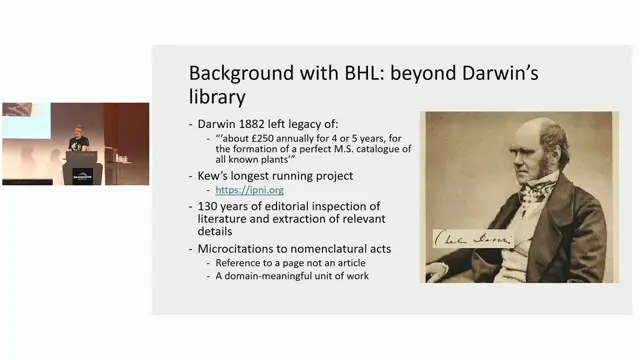
Possibilities to enhance the semantic navigation of BHL: further developing the 'unit of work'
Letting user communities carve BHL into branded, pre-filtered 'hosted portals' could serve diverse needs, satisfy funders and drive innovation.
BHL and the Planetary Knowledge Base: Structuring Biodiversity Literature for the Next Generation
NHM is re-OCRing all of BHL with modern models and extracting entities into a knowledge graph, with confidence gating to protect BHL data quality.
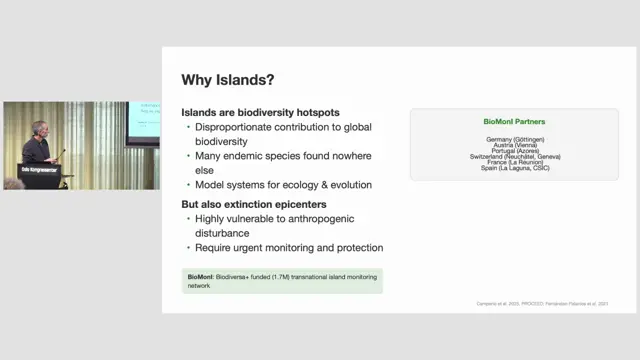
Literature triage to support Island Biodiversity Monitoring
Classifier-based literature triage matches human curators at a fraction of LLM cost and is worth investing in for recurring curation tasks.