
The Planetary Knowledge Base: an infinite solutions engine converting data into action for nature
Vincent Smith · Large Language Models for Biodiversity Data Discovery, Integration, and Curation. Part A: AI- enabled knowledge creation and extraction
The short versionThe NHM is building the Planetary Knowledge Base in phases, with provenance, attribution and benefit-sharing designed in, to move biodiversity data to evidence to action at scale.
What this was about
Vince Smith set out the Natural History Museum's vision of a Planetary Knowledge Base (PKB): infrastructure that combines knowledge graphs, foundation models and LLMs to connect fragmented biodiversity data at scale. He described phase-one projects: a new BHL discovery layer built on re-OCRed literature with Mistral, SCRIBE for label and card transcription, and an internal 'Museum Digital Backbone' built on Amazon Quick. He also described design principles that track provenance, attribution and benefit through the value chain, including remuneration models. Questions covered alignment with the CARE principles and dependence on AWS.
Why it matters. It is an ambitious attempt to build community-scale AI infrastructure for biodiversity. It says openly that big tech partners and commercial revenue will be needed, and that fair returns to data contributors are an open research problem.
In the room
- The big questions: moving data to evidence to action at scale, with continually growing data (10,000-20,000 records a day), unpredictable and urgent questions, provenance, and financial as well as ethical sustainability.
- The PKB aligns big data infrastructures (people, observations, collections, institutions, genetics, literature) using knowledge graphs plus foundation models and LLMs, and builds services on top.
- Because of the scale, the work is split into phased projects; the PKB is still in phase one.
- Literature layer: BHL has been almost entirely re-OCRed with Mistral, and institutions, taxa, specimens and articles are extracted into a new discovery layer.
- SCRIBE is the solution for transcribing card indexes, labels and herbarium sheets.
- Museum Digital Backbone: a miniature knowledge graph plus LLM over internal, non-shareable data (grant proposals, publications), built quickly with Amazon Quick.
- Design principles: preserve identifiers, provenance and licences at every step; make contributions visible through attribution; share benefits, possibly through remuneration models.
Notable moments
Transcript
Automatically generated captions can contain mistakes, especially in names and technical terms. Times are relative to the room recording.
Read the transcript ↓
Related talks.
BHL and the Planetary Knowledge Base: Structuring Biodiversity Literature for the Next Generation
NHM is re-OCRing all of BHL with modern models and extracting entities into a knowledge graph, with confidence gating to protect BHL data quality.
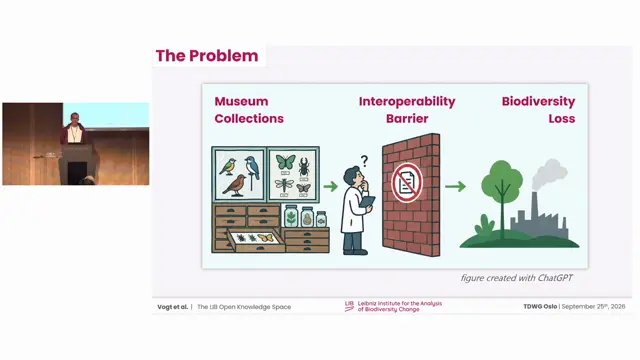
The LIB Open Knowledge Space: A semantic architecture for FAIR, CLEAR, and AI-ready biodiversity knowledge
Knowledge can enter the LIB Open Knowledge Space as natural language immediately and be formalised step by step, so content becomes FAIR, CLEAR and AI-ready incrementally.
The More Extended, The More Open: Semantic Integration of 3D Natural Heritage Data into Biodiversity CMS
Treating 3D specimen models as entry points in a knowledge graph that includes heritage context and digitisation paradata makes them reusable knowledge assets.