
Explore the conversation.
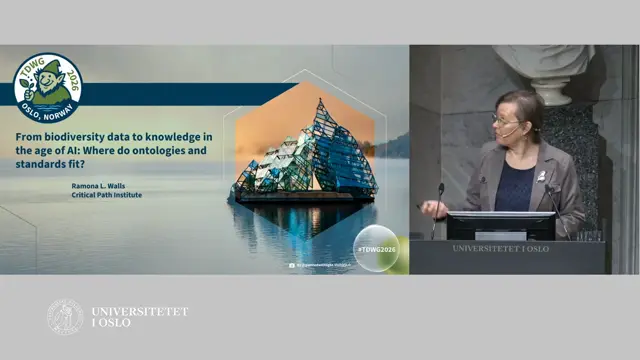
From biodiversity data to knowledge in the age of AI: where do ontologies and standards fit?
AI can generate data and candidate knowledge, but only standards, ontologies, provenance and governance let data become trusted evidence and therefore knowledge, which is why TDWG matters more than ever.
Ramona Walls ↗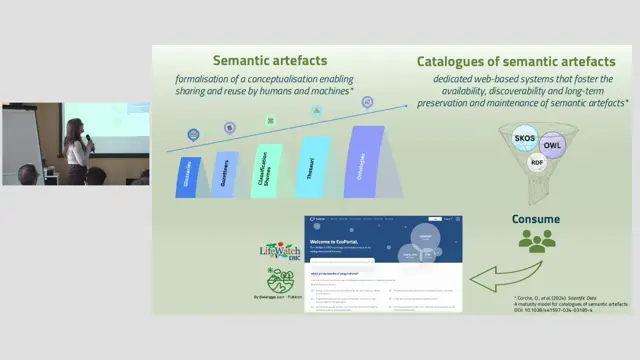
Infrastructure-driven solutions to strengthen semantic interoperability in ecology
A federated terminology service over 28 catalogs plus community alignments tackles the fragmentation of ecological vocabularies.
Cristina Di Muri ↗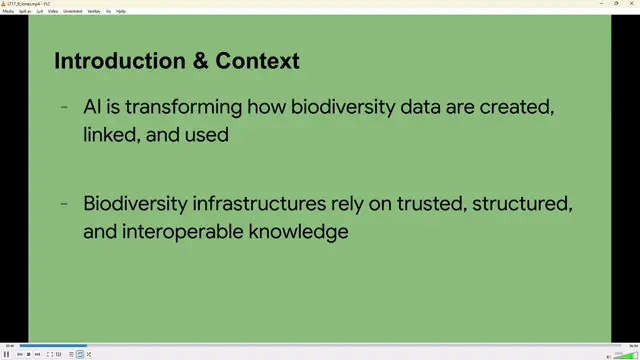
Semantic Governance and Knowledge Organization in AI-Augmented Biodiversity Infrastructures
AI-generated biodiversity knowledge must be provenance-aware and anchored in shared vocabularies, making AI-assisted rather than AI-directed curation.
Andrew Jones ↗
Aligning An Evolving Global Data Model To Software With Global Ambitions: GBIF x TaxonWorks
TaxonWorks and DwC-DP have converged conceptually, but exchange between rich models will always be lossy, so mappings should be recorded explicitly.
Matthew Yoder ↗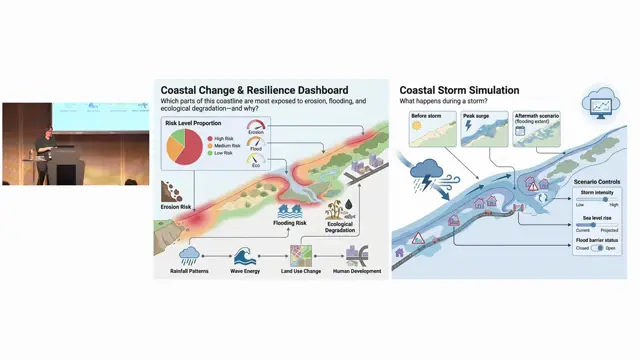
Beyond Data Integration: Ecological and Semantic Interoperability in Coastal Digital Twins
Coastal digital twins expose a long list of unresolved land-sea interoperability gaps, from vertical datums and shifting shorelines to missing cross-domain ontologies.
Laura Slaughter ↗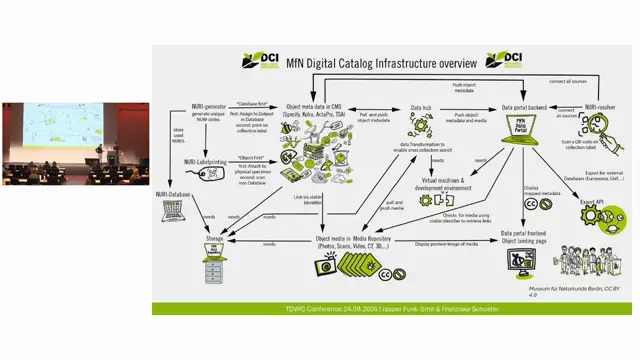
Everything is coded: How to prevent a game of telephone in a system full of interfaces
Shared understanding of what data means must be established at the start of a pipeline; standard formats alone won't stop meaning drifting between people.
Franziska Schuster, Jasper ↗
Panel discussion: From Mobilizing Data to AI-Ready Knowledge
AI-readiness is purpose-dependent, and the hardest remaining problems are social: trust, attribution, governance and data sovereignty, where ontologies and knowledge graphs offer some control and explainability.
Hilmar Lapp, Robert Guralnick, Tanya Berger-Wolf ↗
Phenobase: a harmonized, AI-ready knowledge base of global plant phenology
Combining ontologies with machine learning lets Phenobase close global phenology data gaps, but making the result AI-ready requires per-record model provenance, quality and citation.
Robert Guralnick ↗
Traits Thesaurus: toward semantic harmonization of FAIR trait-based data on aquatic organisms
A community-validated SKOS thesaurus of aquatic trait terms and units can make open trait data genuinely interoperable across taxa.
Jessica Titocci ↗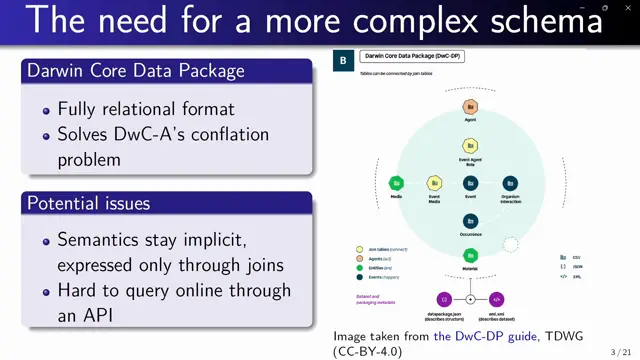
Enabling machine-readable access to biodiversity data through federated semantic querying
Distribute the data, not the infrastructure: cloud Parquet plus OBDA query rewriting gives a virtual Darwin Core knowledge graph without duplicating data into RDF.
El-Amine Mimouni ↗