
LT17 closing Q&A: AI hallucinations, validation and lightning-talk format
Jack Hollister, Haris, Tanya Berger-Wolf · Bots, Bits, and Biodiversity
The short versionValidation of large-scale AI output remains open; for ML classifiers, accuracy should be judged on the ecological task rather than benchmark metrics.
What this was about
After the lightning talks the moderators opened questions. Besides questions to individual speakers (captured with those talks), an audience member asked whether speakers found hallucinations when reviewing AI outputs. The answer (apparently from a collaborator of Jenna Kline) was that non-generative ML tools don't hallucinate but misclassify, and accuracy should be evaluated at the ecological task level because of distribution shift; Jack Hollister acknowledged validating vast LLM outputs is an unsolved problem; a relayed comment argued ML behaviour annotation beats humans. The session closed with feedback that Q&A in lightning sessions needs better support.
Why it matters. Highlights evaluation practices for AI in biodiversity and practical lessons for running lightning sessions.
In the room
- Question to all: have you found hallucinations, and does not finding any mean none exist or they were undetected?
- Answer: non-generative ML has no hallucinations but has expected misclassifications; evaluate accuracy at the ecological task level because ML accuracy is misleading once deployed under distribution shift.
- Jack Hollister: LLM outputs are too large to validate fully; how to find small hallucinations is an open question.
- Relayed from Jenna Kline: ML-based behaviour classification can be better than human analysis; latent-space approaches (Max Planck Institute of Animal Behavior) address unnamed behaviours.
- Audience feedback: the one-minute format and app made asking questions hard; moderators suggested better aids listing talks at the end.
Notable moments
Transcript
Automatically generated captions can contain mistakes, especially in names and technical terms. Times are relative to the room recording.
Read the transcript ↓
Related talks.
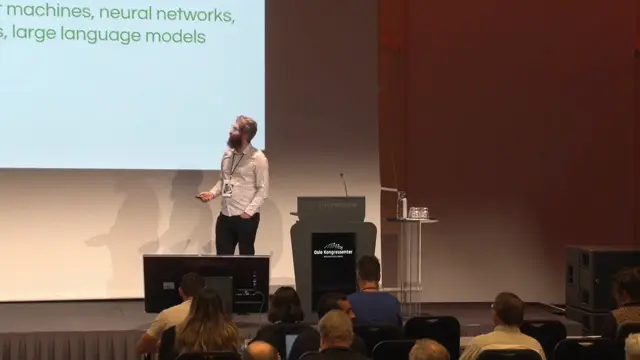
Introduction to the AI for Biodiversity Data session: what machine learning and LLMs actually do
LLMs are word predictors with no notion of truth, so their outputs, including hallucinations, cannot be objectively scored from the text alone.
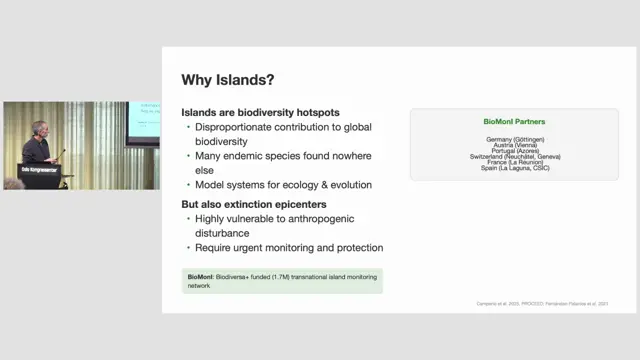
Literature triage to support Island Biodiversity Monitoring
Classifier-based literature triage matches human curators at a fraction of LLM cost and is worth investing in for recurring curation tasks.
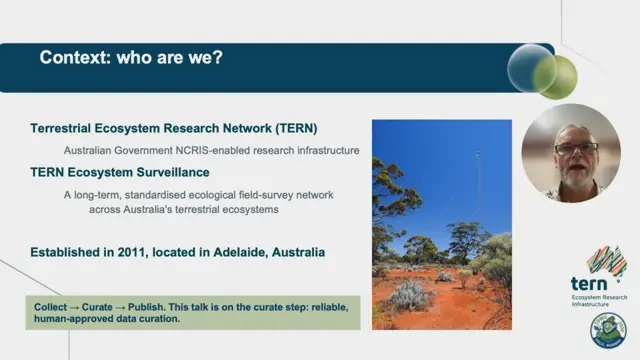
Reliable LLM-assisted curation of ecological survey data: a deployed agent bridging field collection and data curation
An LLM agent that proposes findings for curator approval, with confirmed patterns turned into deterministic rules, catches plausibility errors that schema validation misses.