
Explore the conversation.
AI-assisted digitisation of printed identification keys: from book to structured data in minutes
An agentic LLM pipeline can turn printed keys and descriptions into a structured draft identification key for tens of dollars, shifting experts from transcribers to reviewers.
Wouter Koch ↗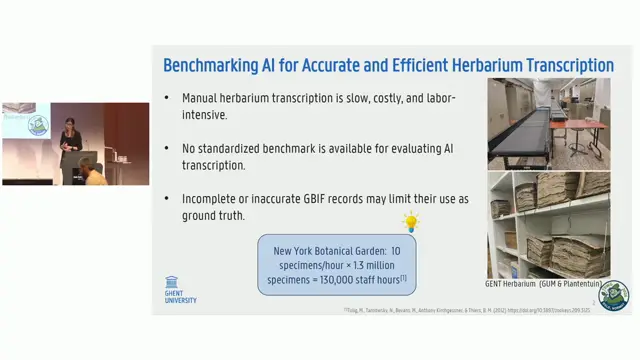
HerbAudit: Validating AI-Driven Herbarium Transcriptions
HerbAudit shows AI herbarium transcription reaching ~94% accuracy and provides a fair, field-aware way to benchmark it.
Dilara Ağacık ↗
Introduction to the AI for Biodiversity Data session: what machine learning and LLMs actually do
LLMs are word predictors with no notion of truth, so their outputs, including hallucinations, cannot be objectively scored from the text alone.
David Williamson ↗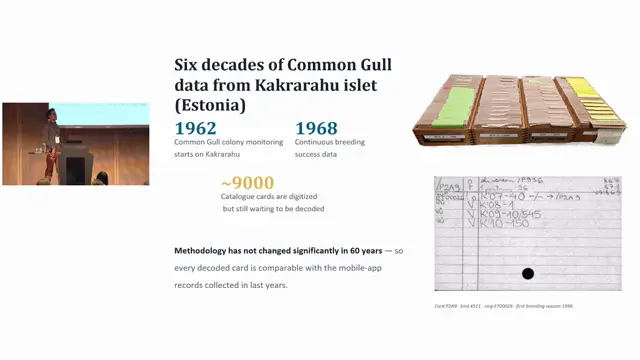
KakraCards: An AI-Assisted Pipeline for Liberating Six Decades of Seabird Heritage Data
Multi-model consensus with human adjudication builds ground truth and picks the best LLM for transcribing standardised historical cards.
Kristjan Adojaan ↗
LT17 closing Q&A: AI hallucinations, validation and lightning-talk format
Validation of large-scale AI output remains open; for ML classifiers, accuracy should be judged on the ecological task rather than benchmark metrics.
Jack Hollister, Haris, Tanya Berger-Wolf ↗
Multimodality for Knowledge Extraction from Historical Entomology Literature
Aligning text and illustrations in a multimodal knowledge graph can generate evidence-grounded captions and recover knowledge lost by text-only extraction.
Jana Hoffmann, Sefika Efeoglu ↗
A metadata-first FAIR4AI checklist and automated evaluation agent for biodiversity datasets
FAIR4AI is mainly a metadata gap, and a community checklist plus an automated agent can measure and help close it while tracking provenance and governance back to data sources.
Tanya Berger-Wolf ↗
From 'Lost in Translation' to Fit-for-Purpose Data: Why Ecologists and Conservation Practice Still Need Groupings and Uncertainties
Biodiversity data systems must be able to record identification uncertainty and taxonomic groupings, or ecologists face a choice between false certainty and lost ecological information.
Bernhard Kløw Askedalen, Natalie ↗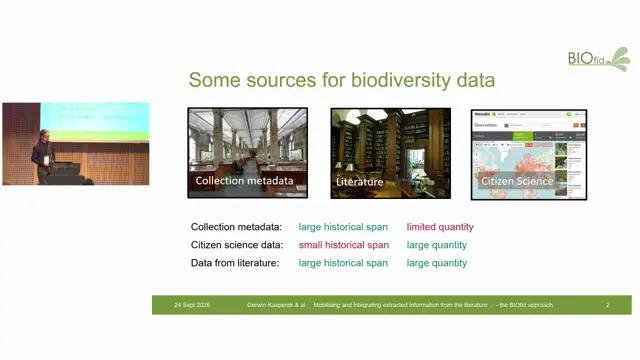
Mobilising and integrating extracted information from the literature into a biodiversity data ecosystem - the BIOfid approach
BIOfid mobilises Central European biodiversity literature with NLP, ontologies and standards, because raw LLM extraction still hallucinates identifiers and needs verification.
Gerwin Kasperek ↗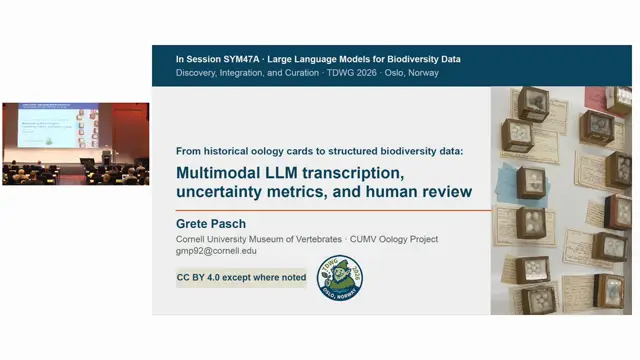
From Historical Oology Cards to Structured Biodiversity Data: Multimodal LLM Transcription, Uncertainty Metrics, and Human Review
Token-level hesitation from log-probabilities does not tell you which transcriptions are wrong, but it reliably predicts where human review effort will go.
Grete Pasch ↗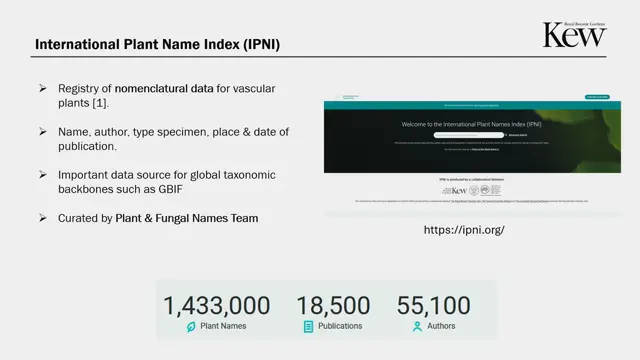
LLM-Based Pipeline for Extracting Nomenclatural Acts from Taxonomic Literature
A grounded, schema-constrained two-pass LLM pipeline extracts IPNI-ready nomenclatural data well once treatments are found; finding treatment boundaries is the bottleneck.
Ishaipiriyan Karunakularatnam ↗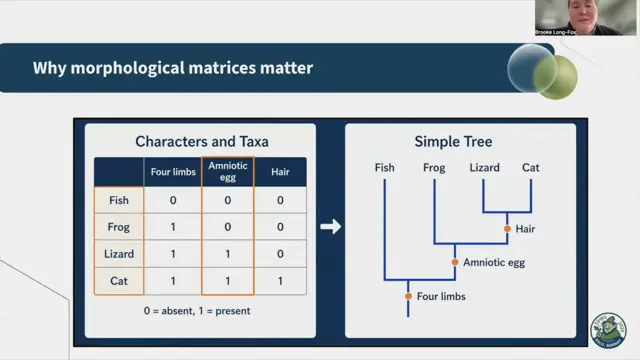
Validating LLM-Extracted Biodiversity Data to Preserve Scientific Meaning
LLM extraction speeds up morphological matrix curation enormously, but errors, including fabrications, appear in almost every output, so expert validation is essential.
Brooke Long-Fox ↗