
Not just another database: building the future of freshwater taxonomy with FADAtims
Astrid Schmidt-Kloiber, Geraldine Mertens · A consensus taxonomic reference for improved freshwater biodiversity data and knowledge
The short versionFADAtims turns the dormant FADA checklists into a living, expert-curated and interoperable freshwater taxonomic infrastructure, but its future depends on sustaining experts and systems.
What this was about
Astrid Schmidt-Kloiber opened with a caddisfly whose accepted name differs between the Trichoptera World Checklist, GBIF/Catalogue of Life and freshwaterecology.info, arguing freshwater biodiversity has a taxonomy problem rather than a database shortage. Geraldine Mertens recounted how the original Freshwater Animal Diversity Assessment produced species lists and a Hydrobiologia special issue but then stagnated, and how the InfraFADA project rebuilt an expert consortium (over 100 experts, 61 animal groups plus macrophytes) with exchanges from WoRMS and TaxonWorks. Astrid then demonstrated FADAtims, the operational curation system with role-based permissions, bulk upload, detail pages linked to GBIF and the IUCN Red List, and exports including DOI-versioned checklists via ChecklistBank, and raised sustainability of people, infrastructure and interoperability.
Why it matters. Consistent freshwater taxonomy underpins occurrence integration, Red List assessment and ecological analysis; FADAtims is intended as the backbone for several freshwater portals.
In the room
- Example: Lepidostoma basale is accepted in the Trichoptera World Checklist and freshwaterecology.info but treated as a synonym in GBIF and Catalogue of Life.
- Freshwater biodiversity has 'not a database shortage, but rather a taxonomy problem'.
- FADA started over 20 years ago; its expert lists and a Hydrobiologia special issue were produced, but maintenance stopped when funding ended due to technology limits and poor machine-to-machine exchange.
- InfraFADA rebuilt the expert consortium: over 100 experts, 61 animal groups plus a macrophyte chapter; 43 Excel templates (24 received, 19 in progress), with 15 lists expected from WoRMS and 3 from TaxonWorks.
- FADAtims supports role-based permissions (expert, expert leader, group member, public), bulk upload, search and filters, and detail pages with taxonomy, environmental information, references and links to GBIF occurrences and the IUCN Red List.
- Experts curate names, synonyms, classification, authorships, FADA environmental regions and distribution; edits are tracked.
- Exports include PDFs, CSV and versioned checklists that receive DOIs through ChecklistBank via ColDP packages; DOIs are the main incentive for experts.
Notable moments
Transcript
Automatically generated captions can contain mistakes, especially in names and technical terms. Times are relative to the room recording.
Read the transcript ↓
Related talks.
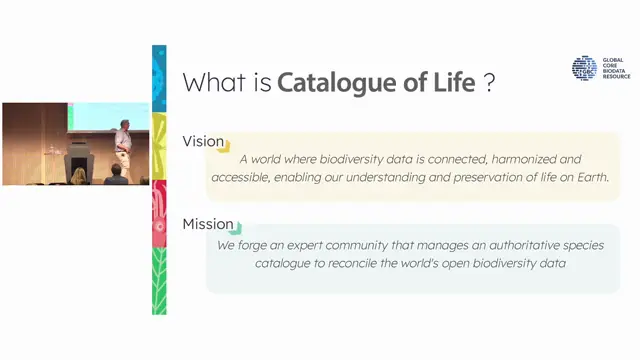
Catalogue of Life and Freshwater species data
Catalogue of Life pledges to model and expose freshwater designations within a year, fed by FADAtims and WoRMS, finally allowing freshwater species and occurrences to be identified via GBIF.
The FIPbio data portal: towards an integrated freshwater biodiversity data ecosystem
FIPbio aims to make freshwater data publishing and analysis easier by combining FADA taxonomy, GBIF occurrences, site context, abiotic and remote-sensing data, and automated catchment annotation.
Freshwater data platforms: acronym soup, abundance, classifications and data quality
The freshwater community prefers connected, specialised platforms feeding GBIF over one system, but must address abundance data, classification consistency and trust in data from diverse providers.