
Explore the conversation.
Address from the TDWG Chair: highlights of the year and TDWG at a crossroads
TDWG has had a productive year, but a growing, more diverse community and the rise of AI put it at a crossroads that needs more volunteers, better documentation and more sustainable maintenance and funding.
David Bloom ↗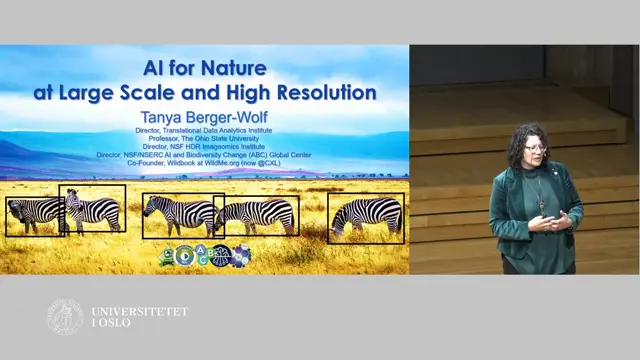
AI for Nature at Large Scale and High Resolution
AI can help fill biodiversity knowledge shortfalls only if biological knowledge is built into the models and the data infrastructure is FAIR for AI and returns value to primary data collectors, because 'there is no AI without data'.
Tanya Berger-Wolf ↗
Closing the Loop: The DiSSCo Annotation Validation Framework for Trustworthy Data Round-Tripping
DiSSCo proposes impact-based, layered validation so trusted annotations are promoted automatically and only high-impact ones need expert review.
Wouter Addink ↗
Delivering AI for biodiversity data in the public sector: data handling, security and humans-in-the-loop when small teams build at pace
Small public-sector teams can use AI tools productively if they set clear boundaries between prototype, dev, test and production and keep expert humans in the loop.
Rachel Wiles ↗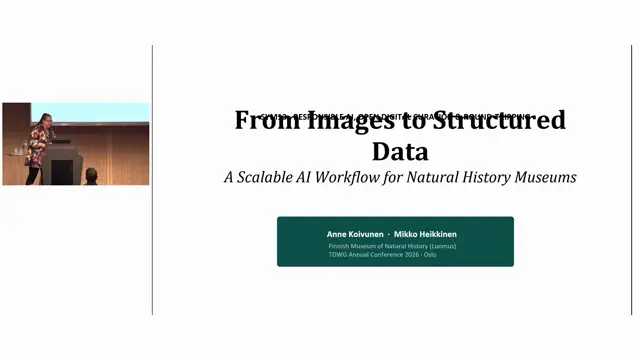
From Images to Structured Data: A Scalable AI Workflow for Natural History Museums
A simple 'just do it' AI transcription pipeline with schema prompts, an intent step and full provenance can make label digitisation scale.
Anne Koivunen ↗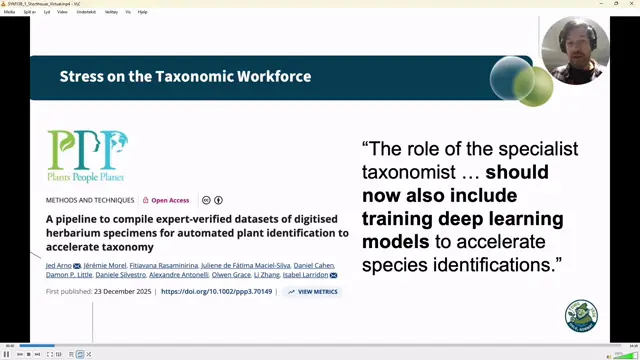
Open Digital Curation and Round-Tripping Biodiversity Data Enhancements Across Collection Infrastructures: Six Years and 50 Million Links in Bionomia
Round-tripping is much harder than expected, and data managers must fully populate identifiedBy so taxonomists' expertise is credited.
David Shorthouse ↗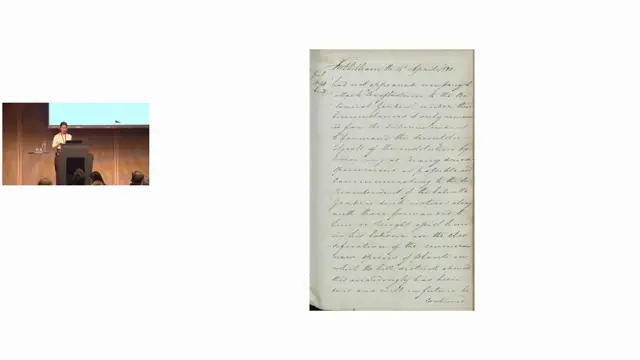
Rediscovering Archives - Using LLM's for the Transcription and Extraction of Ecological Data from Historical Archives
Off-the-shelf multimodal LLMs can transcribe varied handwritten archives well, with closed models more robust on structured tables.
Phoebe Santos ↗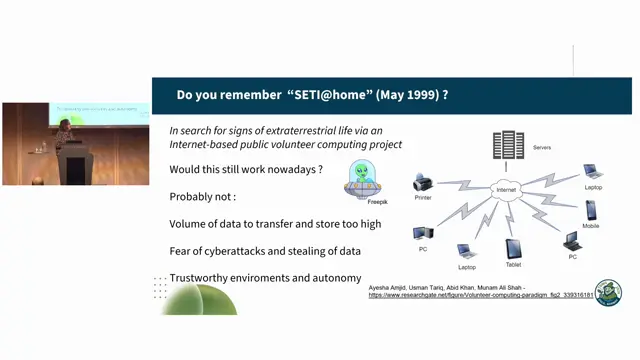
Responsible and GreenAI: Does our community need Gigantic Data Centers to deliver?
Biodiversity researchers mostly need AI-ready data rather than giant data centres, and AI use should be weighed against its environmental cost.
Patricia Mergen ↗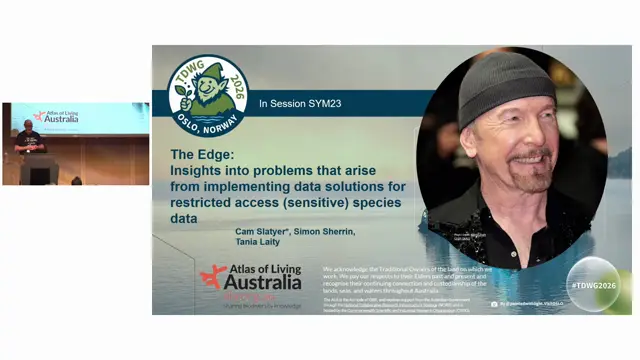
The Edge: Insights into problems that arise from implementing data solutions for restricted access (sensitive) species data
Plan RASD treatments carefully, because taxonomy, data errors and associated records can silently defeat simple rules like 'generalise to 10 km'.
Cameron Slatyer ↗
Panel discussion: From Mobilizing Data to AI-Ready Knowledge
AI-readiness is purpose-dependent, and the hardest remaining problems are social: trust, attribution, governance and data sovereignty, where ontologies and knowledge graphs offer some control and explainability.
Hilmar Lapp, Robert Guralnick, Tanya Berger-Wolf ↗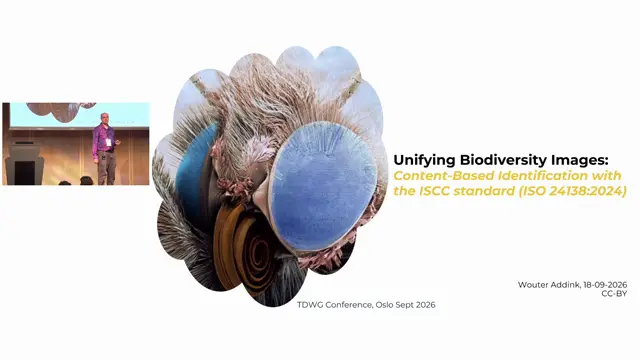
Unifying Biodiversity Images: Content-Based Identification with the ISCC standard (ISO 24138:2024)
ISCC gives images a content-derived, similarity-comparable identifier that anyone can recompute, addressing duplication, broken links and AI-generated fakes.
Wouter Addink ↗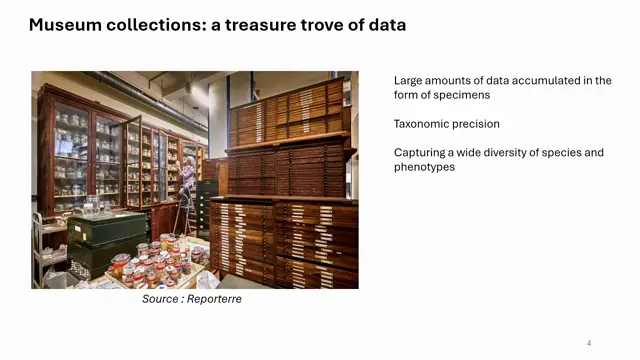
Beyond traditional identification keys: hybrid deep learning and Xper3 keys for insect identification
Deep-learning pre-filtering of an interactive key keeps the key's explainability while greatly shortening identification paths.
Agathe Puissant ↗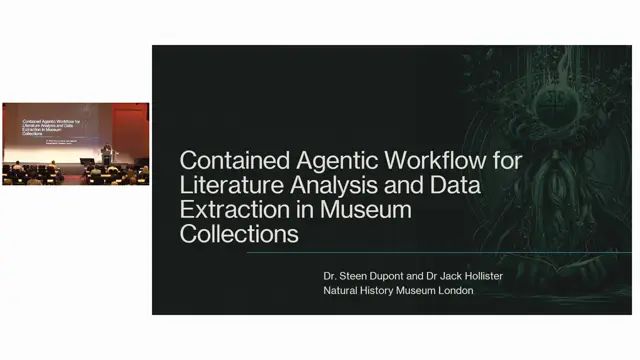
Contained Agentic Workflow for Literature Analysis and Data Extraction in Museum Collections
Contained, local agentic RAG over a literature corpus is feasible on a laptop or shared edge machine, avoiding the security worries of cloud agents in museums.
Steen Dupont ↗
Structured identification keys complementing AI: closing the corpus bottleneck with AI-assisted digitisation
AI and identification keys are complementary, and LLM-assisted digitisation of printed literature now makes it feasible to build structured keys at scale for expert review.
Wouter Koch ↗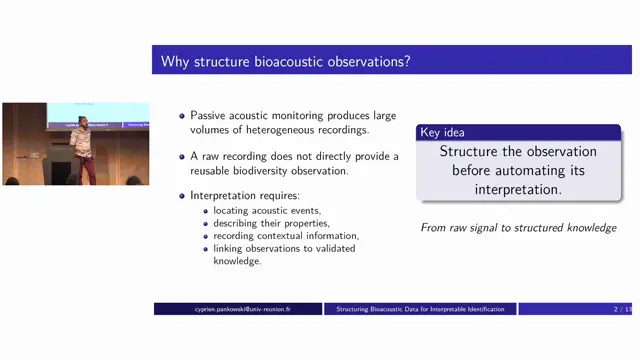
The Iterative Signal-Based System (ISBS): Structuring Bioacoustic Data for Interpretable Identification
Describing cetacean vocalisations with explicit descriptors and symbolic classification gives interpretable, taxonomy-like structure to bioacoustic data before large-scale AI.
Cyprien Pankowski ↗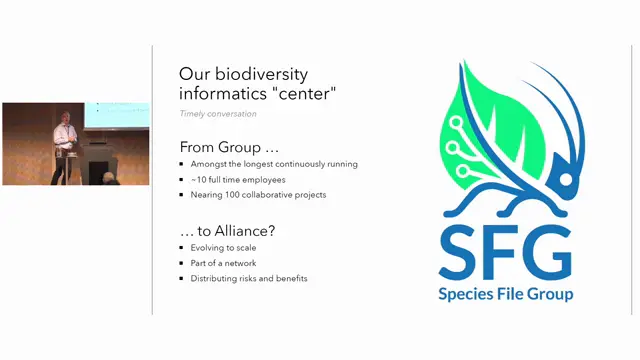
What is the Role of "AI" in the Centers for Biodiversity Informatics of the Future?
Biodiversity informatics centres are about people. AI raises the importance of standards, storage, openness and distributed risk, and centres should fuel researchers' curiosity rather than be driven by the technology.
Matthew Yoder ↗