
Delivering AI for biodiversity data in the public sector: data handling, security and humans-in-the-loop when small teams build at pace
Rachel Wiles · AI for Biodiversity Data
The short versionSmall public-sector teams can use AI tools productively if they set clear boundaries between prototype, dev, test and production and keep expert humans in the loop.
What this was about
Rachel Wiles, product manager for the Natural History Museum's Data Ecosystem (a biodiversity data platform for largely urban UK nature built with AWS), described how a very small tech team uses AI tools to build at pace. She set out three boundaries of AI use: Claude Design for UI prototyping with dummy data, AWS Kiro as a code assistant running within the museum's AWS account for governance and logging, and GitLab agents for automated code review before deployment. She listed team rules (no AI acting on production data, no promoting unrewritten prototype code beyond dev, never bending the data model to a mock-up) and described human-in-the-loop verification tools (duplicate detection, PII/human detection, species clustering) surfaced as suggestions to expert verifiers. She asked the community for ideas on validation and provenance.
Why it matters. Offers a candid, practical model of AI governance for under-resourced biodiversity data teams, and raises the open problem of preserving provenance and credit when AI assists data workflows.
In the room
- The Data Ecosystem aggregates eDNA, environmental sensing, community science and camera trap data with quality checks; 10 million records in its first six months.
- Built in a four-year AWS partnership by a tiny team (a data engineer, a senior engineer and a product manager) with consultants filling gaps.
- Claude Design is used for wireframes and prototypes with generated dummy data, avoiding museum IP or real records.
- AWS Kiro sits inside the AWS account, allowing central access control and logging of model use.
- GitLab agents add automated code review before deployment.
- Organisations without an AI policy should get one now; retrofitting code to a policy is hard.
- AI-assisted outputs (duplicate detection, PII checks, species clustering) arrive as suggestions for Centre for UK Nature experts to action.
Notable moments
Transcript
Automatically generated captions can contain mistakes, especially in names and technical terms. Times are relative to the room recording.
Read the transcript ↓
Related talks.
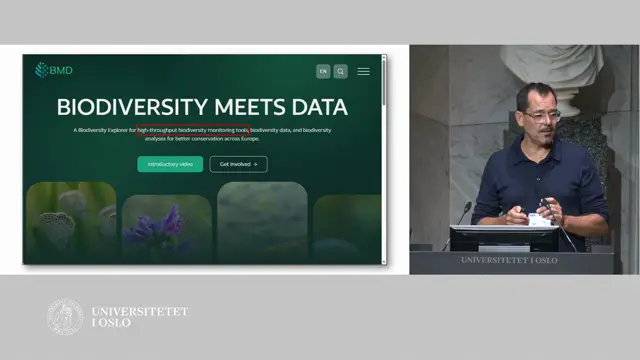
Mainstreaming high-throughput biodiversity monitoring using AI
AI identification platforms like ARISE can take sensor data automatically to GBIF-published, standardised data for protected-area managers, but training costs are high and human verification still matters.
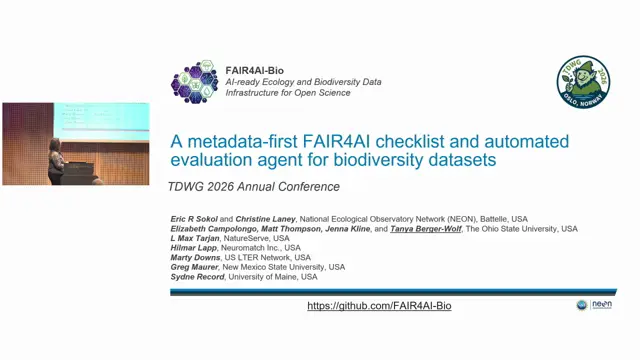
A metadata-first FAIR4AI checklist and automated evaluation agent for biodiversity datasets
FAIR4AI is mainly a metadata gap, and a community checklist plus an automated agent can measure and help close it while tracking provenance and governance back to data sources.
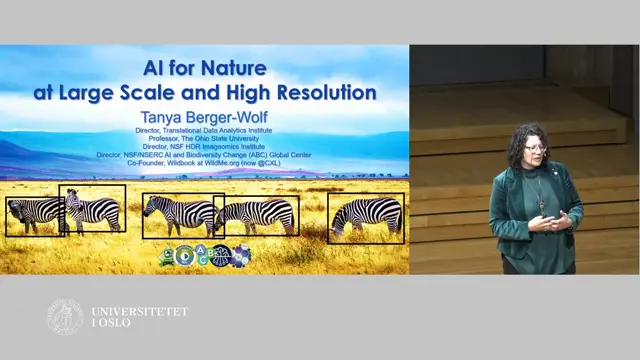
AI for Nature at Large Scale and High Resolution
AI can help fill biodiversity knowledge shortfalls only if biological knowledge is built into the models and the data infrastructure is FAIR for AI and returns value to primary data collectors, because 'there is no AI without data'.