
Explore the conversation.
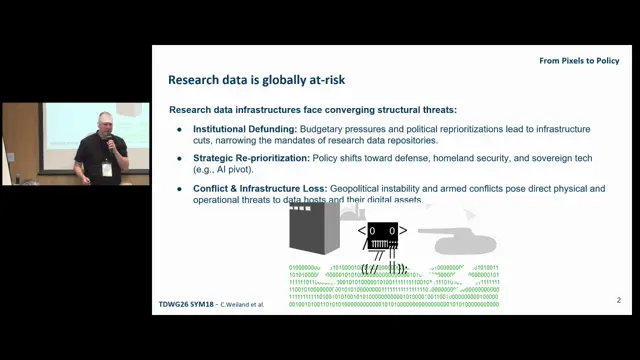
From Pixels to Policy: Closing the Gap between In Situ Monitoring, Earth Observation, and Policy Actionability
Packaging data with its semantics, provenance and machine-readable policy as FAIR Digital Objects makes it rescue-ready and redeployable elsewhere.
Claus Weiland ↗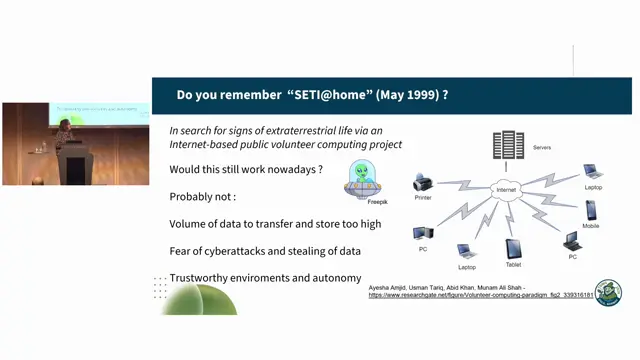
Responsible and GreenAI: Does our community need Gigantic Data Centers to deliver?
Biodiversity researchers mostly need AI-ready data rather than giant data centres, and AI use should be weighed against its environmental cost.
Patricia Mergen ↗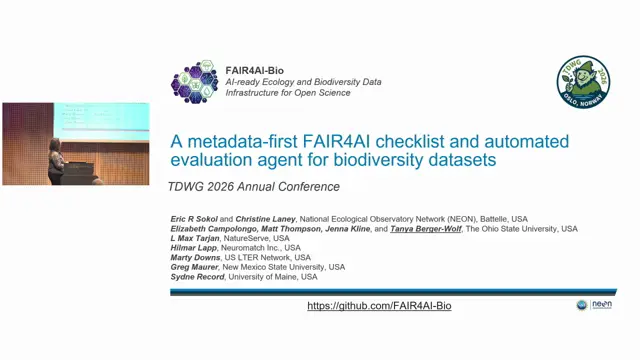
A metadata-first FAIR4AI checklist and automated evaluation agent for biodiversity datasets
FAIR4AI is mainly a metadata gap, and a community checklist plus an automated agent can measure and help close it while tracking provenance and governance back to data sources.
Tanya Berger-Wolf ↗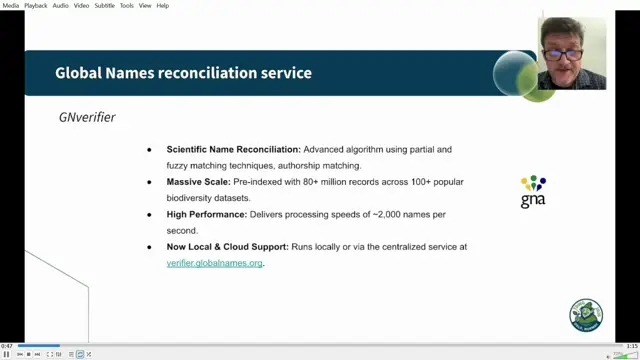
Local scientific name resolution using custom data sources
GNverifier can now be run locally over any custom or private name datasets, using the standardised SFGA format and GNdb, with the same API as the central service.
Dmitry Mozzherin ↗
Panel discussion: From Mobilizing Data to AI-Ready Knowledge
AI-readiness is purpose-dependent, and the hardest remaining problems are social: trust, attribution, governance and data sovereignty, where ontologies and knowledge graphs offer some control and explainability.
Hilmar Lapp, Robert Guralnick, Tanya Berger-Wolf ↗