
The Iterative Signal-Based System (ISBS): Structuring Bioacoustic Data for Interpretable Identification
Cyprien Pankowski · May the Data Be Structured: Linking Descriptions, Identification and AI
The short versionDescribing cetacean vocalisations with explicit descriptors and symbolic classification gives interpretable, taxonomy-like structure to bioacoustic data before large-scale AI.
What this was about
Pankowski presented ISBS, a hybrid neural-symbolic framework for classifying cetacean vocalisations from passive acoustic monitoring. It works in three phases: detection (manual now, neural detection in progress), description (45 acoustic descriptors plus contextual metadata such as location and recordist), and classification with IKBS, a symbolic knowledge-based system from his lab. A proof of concept on over 500 events from the Watkins marine mammal sound database classified vocalisations into harmonic, impulsive and stationary acoustic domains. In Q&A an audience member explained that Camtrap DP is being adapted as a TDWG standard for bioacoustic data.
Why it matters. Neural classifiers are opaque, and there is no consensus on how to describe cetacean calls. A descriptor-based, interpretable approach could support a shared ontology of vocalisations and studies of how calls vary over time and between populations.
In the room
- Passive acoustic monitoring yields weeks of recordings with sparse events (e.g., minke whales detectable 100 km or more away), so manual processing is very time-consuming.
- Neural networks classify well but lose the information on why a call is classified as it is. Annotators also disagree on how many vocalisations a spectrogram contains, and there is no international consensus.
- Detection: neural approaches are acceptable for detection because explainability matters less there. Manual detections supply known cases for the knowledge base, and boat noise is a major problem.
- Description: 45 acoustic descriptors (temporal, spectral/frequency, cepstral) plus contextual metadata such as recording location and recordist, together with any expert annotations.
- Classification uses IKBS, a knowledge-based system developed about 20 years ago in the lab for corals and turtles and adapted here to vocalisations.
- Proof of concept: Watkins marine sound database, seven cetacean species seen around Reunion, more than 500 events, classified into harmonic, impulsive and stationary domains or combinations. Results were described as promising; the transcribed accuracy figure is garbled.
- Next: classify vocalisation types rather than species. The long-term hope is individual-level recognition and a consensus ontology of cetacean vocalisations.
Notable moments
Transcript
Automatically generated captions can contain mistakes, especially in names and technical terms. Times are relative to the room recording.
Read the transcript ↓
Related talks.
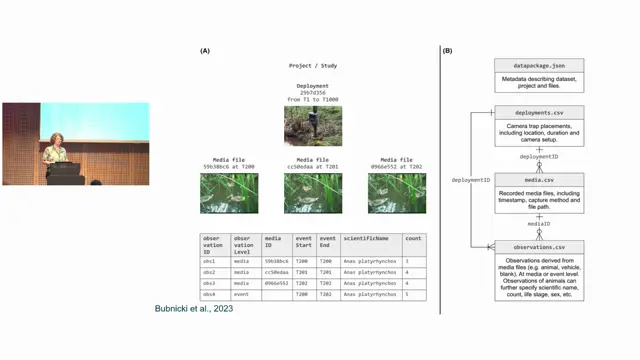
Camtrap DP: extending data standard designed for camera trapping research to support AI workflows and new data sources
Camtrap DP fits data from any stationary sensor, and converging community feedback shows how to extend it for AI provenance and multimodal monitoring.
Soundscape China: Listening to the Sounds of Nature with AI
Soundscape China is building a nationwide acoustic sensor network, database and AI models, gathering 3.6 million recordings in its first year.
From sampling-event datasets to the Humboldt Extension: a TaiBIF assessment and pilots for long-term monitoring in Taiwan
Giving monitoring-data providers immediate site-level trend feedback, based on a minimal set of Humboldt terms, can motivate adoption better than asking for the full extension.