
From Silos to Standards - Advancing Standardised Collection State Documentation for Institutional Continuity and Coordination
Jacobus Christiaan Steenkamp · From Cabinets to Clouds - Bridging the gap between collection- and database management
The short versionStandardising how collection state (readiness, risk, conditions) is recorded turns tacit curatorial knowledge into shared, comparable institutional memory.
What this was about
Christiaan Steenkamp described how South Africa's NSCF supports a network of about 23 partner institutions, many without data managers, in documenting the state of their collections. Tacit knowledge about readiness, risk and conditions usually sits with individual staff. A 2021 community collection management and conservation manual led to a national collection assessment. Its first tracking tool, built on Google Forms, Apps Script and Looker Studio in 2025, was then refactored with agentic development into a standalone system. The new system scores implementation, documentation and risk, links specimens to jars, preservation batches and storage conditions, enriches records from GBIF with IPT-ready export, keeps audit trails and generates handover documents. It works alongside Specify and BRAHMS.
Why it matters. Collection state and curatorial history are largely missing from current standards. This work shows how a national network with thin staffing can capture them, and it points to a gap beyond Latimer Core.
In the room
- The NSCF network covers about 23 partner institutions, from full teams to single staff members, built over nine years.
- Darwin Core describes occurrences and Latimer Core describes collections, but collection state, readiness and risk are not captured in shareable form.
- A community collection management and conservation manual (2021) led to a national assessment scored with taxon experts and observers.
- The first Google Stack tracking pipeline (Forms, Apps Script, Looker Studio) was view-only, tedious to update and hard to scale.
- The refactored system scores implementation, documentation and risk, lets institutions customise questions, and uses role-level security.
- It links specimens to jars, preservation batches, fluids and environmental conditions, keeps an audit log and generates customisable handover documents for staff continuity.
- GBIF data can be pulled in, edited with tracking, and exported in IPT-ready format; the system works alongside Specify and BRAHMS rather than competing with them.
Notable moments
Transcript
Automatically generated captions can contain mistakes, especially in names and technical terms. Times are relative to the room recording.
Read the transcript ↓
Related talks.
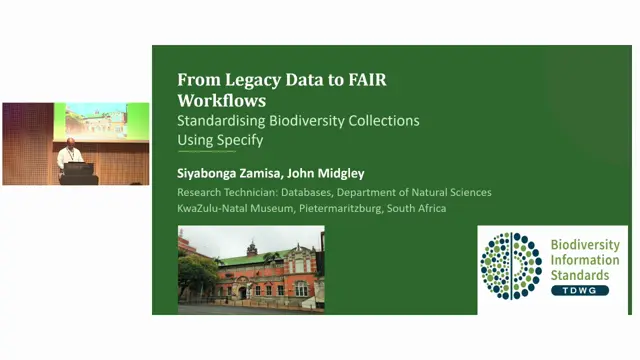
From Legacy Data to FAIR Workflows: Standardising Biodiversity Collections Using Specify
Standardised workflows, not just a new database, turned 11 differently managed collections into GBIF-ready data.
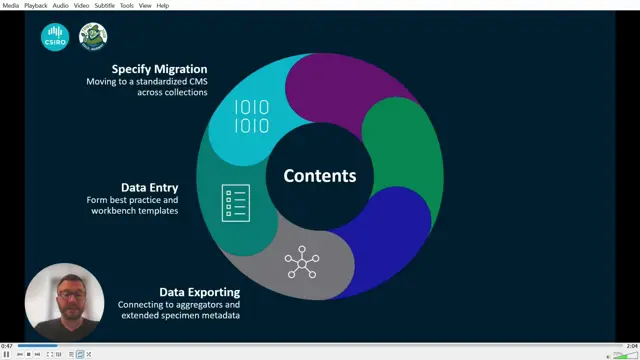
From Data Entry to Distribution: Streamlining Biodiversity Workflows with Specify at CSIRO
Layered standards in templates, roles and training let CSIRO keep five Specify instances consistent while each collection keeps its own outputs.
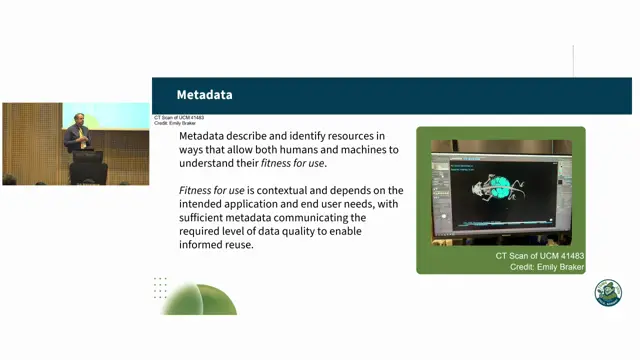
Metadata matters: perceptions on the implementation of Darwin Core in the biocollections cyberinfrastructure
Standardisation through Darwin Core can mask nuance, and practitioners report complex data, missing guidelines and limited capacity as the main implementation barriers.