
SYM18 discussion: who sustains biodiversity data infrastructures?
Eva Alonso, Giuditta Parolini, Mareike Petersen, Claus Weiland, David Shorthouse, Matthew Blissett, Siobhan Leachman, Sharon, Vince, Wouter, Deborah, Nicky · Building resilient data infrastructures for biodiversity science
The short versionVolunteer and single-developer infrastructures deliver proven value, but the community lacks mechanisms and funding to protect them.
What this was about
The discussion moved from where project materials should live after projects end to how to break down the divide between infrastructure providers and users. Speakers stressed that bottom-up volunteer effort cannot replace hardware, system ownership and stable funding; David Shorthouse urged every project to decide what is 'fail-safe' and what is 'safe to fail'. Audience members (Siobhan Leachman, Sharon from the Field Museum) lamented that Bionomia depends on one self-funded person and argued that data infrastructure needs its own governance and support distinct from transient research projects; others raised accreditation as a sustainability route, an impending 'tidal wave' of LLM-built fragile apps, the vulnerability of small data providers to crawlers, and whether infrastructures could recoup crawler costs.
Why it matters. It surfaces the unresolved gap between research-project funding and long-term infrastructure support that underlies many resilience problems in biodiversity informatics.
In the room
- Plan from the start where project materials will live and in accessible formats; possibly in more than one place.
- Bottom-up participation helps with intellectual work, but repositories and bot defence need hardware and system ownership beyond volunteers' time.
- Project-to-project funding leaves infrastructures dependent on single people; consortia of research infrastructures can make joint value cases for sustained funding.
- Decide what is 'fail-safe' and what is 'safe to fail'; Bionomia mints no new identifiers so its links persist if it ends.
- Data infrastructure needs governance, resilience and support distinct from transient research; openness builds communities that step up in crises.
- Accreditation (as used by UK cultural heritage) could help tap national funding; DiSSCo is still developing this.
- LLM tools will let anyone build full-stack biodiversity apps; the community should anticipate thousands of fragile projects.
Notable moments
Transcript
Automatically generated captions can contain mistakes, especially in names and technical terms. Times are relative to the room recording.
Read the transcript ↓
Related talks.
Discussion: designing institutional biodiversity knowledge and data science centres
Interoperable institutional knowledge spaces depend less on technology than on people, shared storage and semantics, incentives and governance.
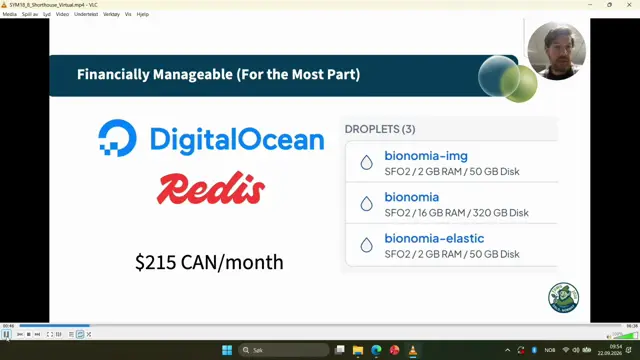
Resilient Attribution Infrastructures for Biodiversity Science: Archiving and Risk Mitigation in Bionomia
Small niche infrastructures can be resilient by planning for their own end: keep things simple and push versioned data and reusable code outward.
Symposium discussion: funding models, open data and sustaining biodiversity infrastructure
The community broadly agreed that core data should stay open, but that products, services, credits, regulation and partnerships must become part of sustaining the infrastructure.