
From sampling-event datasets to the Humboldt Extension: a TaiBIF assessment and pilots for long-term monitoring in Taiwan
Jerome Chie-Jen Ko · From Standards to Implementation: Connecting Observation Data in Asia to GBIF Infrastructure
The short versionGiving monitoring-data providers immediate site-level trend feedback, based on a minimal set of Humboldt terms, can motivate adoption better than asking for the full extension.
What this was about
Jerome Chie-Jen Ko argued that monitoring-data standards will be adopted when they return value to data providers, and proposed a 'trend-ready minimum' as a step between sampling-event data and the full Humboldt Extension. Of 140 Taiwanese GBIF datasets, 52 are sampling-event datasets; screening for comparable sites, comparable effort and at least three years of replication identified 15 strong candidates spanning 3-17 years, mostly birds. Pilots are the Taiwan Breeding Bird Survey and passive acoustic monitoring sites, each needing just three Humboldt terms on target taxonomic scope, excluded scope and whether the scope was fully reported, with a planned feedback service returning site-level trends and reliability indices to providers.
Why it matters. It offers a pragmatic adoption path for the Humboldt Extension and a way to rescue long-term monitoring data held by individuals and citizen-science groups.
In the room
- Each step from occurrence to event to Humboldt data asks more of providers, and they need to see new value in return.
- Occurrence data sharing in Taiwan took off once providers saw their dots on a map; the analogue for monitoring data would be trend information returned on sharing.
- A lightweight trend service needs one comparable site, comparable effort, temporal replication, a defined taxonomic scope and observation state; even a single long-monitored site is valuable.
- For datasets already published as sampling events, three Humboldt terms matter most: target taxonomic scope, excluded taxonomic scope, and whether the taxonomic scope is fully reported.
- Taiwan has nearly 25 million GBIF occurrences and 140 datasets, 52 of them sampling-event datasets; 15 datasets meet trend-readiness criteria, covering 3-17 years, mostly birds but also plants, crabs, fishes and insects.
- Pilot 1: the Taiwan Breeding Bird Survey (target Aves, excluding Strigiformes, which the method does not detect reliably).
- Pilot 2: passive acoustic monitoring sites, using reproducible segmentation of scheduled audio to get comparable effort and declaring the classifier's target list and unreliable species.
Notable moments
Transcript
Automatically generated captions can contain mistakes, especially in names and technical terms. Times are relative to the room recording.
Read the transcript ↓
Related talks.
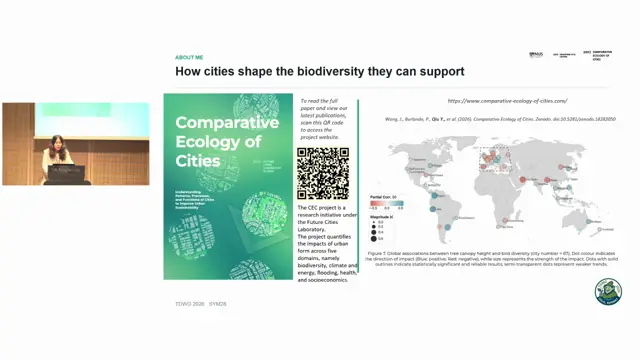
Reporting structure and sampling-bias correction in citizen-science bird data across Asian cities
Abundant citizen-science records do not guarantee inference support; reporting structure can distort richness hotspots and urban-biodiversity relationships unless it is diagnosed and controlled.
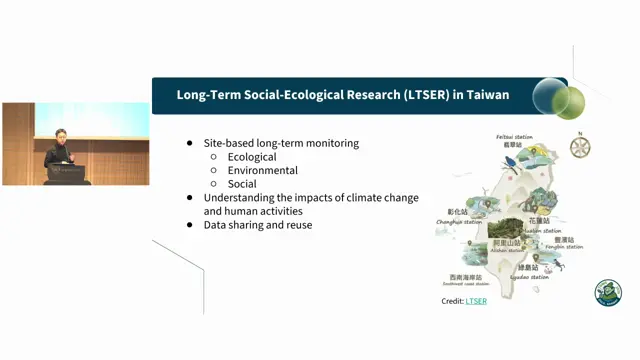
Building a Living Publication Workflow for Long-Term Social-Ecological Monitoring Data: The Taiwan LTSER Experience
Embedding Darwin Core alignment as automated checkpoints in a repository-based pipeline keeps continuously updated monitoring data flowing to GBIF.
Closing Gaps in Specimen Metadata: A Collaborative Annotation and Feedback Platform for Natural History Collections
A national collaborative annotation platform with AI-assisted transcription can close metadata gaps across many Taiwanese collections.