
Trapper 2.0: scalable, open-source platform for managing camera trapping projects with integrated AI pipelines
Karolina Kuczkowska · AI for Biodiversity Data
The short versionTrapper 2.0 offers an open, model-agnostic, edge-deployable pipeline for camera trap photos and videos with expert review and Camtrap DP export.
What this was about
Karolina Kuczkowska presented Trapper, a ten-year-old open-source data infrastructure for camera trapping projects, and its forthcoming version 2, which adds video analysis. Its customisable AI pipeline chains object detection (MegaDetector or YOLO models), species classification, multi-object tracking with custom post-processing, pose estimation and, in development, depth estimation for population density methods, with experts correcting results in the interface. New models can be added via a form or a Python connector class. Trapper runs wherever Docker runs, from cloud servers to NVIDIA Jetson or Raspberry Pi; the WildLabs-funded Trapper Keeper field box enables edge processing, which she argued is key for hotspots without infrastructure, data security and lower environmental impact. Data export in Camtrap DP allows publication to GBIF via the IPT, with direct publication planned.
Why it matters. Manual camera trap analysis can delay results by a year or more; an open, scalable pipeline that runs even offline in the field brings automation to where biodiversity is.
In the room
- Trapper is a suite of tools (GUI, back end, AI components, command-line tools), fully open source on GitLab.
- Version 2 supports videos and is planned for official release before the end of the year.
- Video counts need tracking to determine whether detections in different frames are the same animal.
- Pose tracking currently improves tracking accuracy; behaviour models are a planned next step.
- Depth estimation, calibrated with objects at known distances, produces per-frame distance maps for population size estimation.
- The full stack including AI runs on CPU, GPU or Hailo accelerators on microservers.
- Over 40 million images processed by partner institutions; Slack community of almost 200 experts.
Notable moments
Transcript
Automatically generated captions can contain mistakes, especially in names and technical terms. Times are relative to the room recording.
Read the transcript ↓
Related talks.
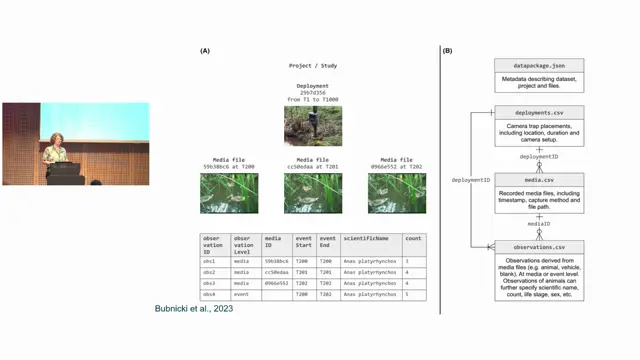
Camtrap DP: extending data standard designed for camera trapping research to support AI workflows and new data sources
Camtrap DP fits data from any stationary sensor, and converging community feedback shows how to extend it for AI provenance and multimodal monitoring.
The WildLIVE Portal: Towards Scalable Wildlife Monitoring through the Integration of Citizen Science and Human-in-the-Loop AI Workflows
WildLIVE combines a model registry, provenance-tracked human verification and FAIR publication to move camera trap data from raw images to publishable data.
Scalable Edge AI for Real-Time Biodiversity Monitoring: tracking invasive plant species in roadside imagery
Distilling a tiling-based plant identifier into a single ConvNeXt model makes high-resolution roadside invasive-species monitoring fast, cheap and more accurate.