
A framework for aligning collections data with the global data ecosystem from data creation to extension in the Smithsonian National Museum of Natural History Department of Paleobiology
Holly Little · From Cabinets to Clouds - Bridging the gap between collection- and database management
The short versionMaking paleo collections work in the global data ecosystem needs an iterative, full life-cycle framework, not one-off digitisation.
What this was about
Holly Little presented the Paleobiology department's new five-year, gift-funded 'paleo digital framework' for the world's largest fossil collection. The collection holds about 42 million objects, 800,000 records, and needs an estimated 10–13 million records. The framework covers the data life cycle from capture to enhancement, extension and publishing. It uses imaging-first capture, adaptable specimen surveys for core data points, material entity type and MIDS, and verbatim preservation before AI text extraction. It also aligns taxonomy and geological context with external sources and feeds corrections back to them, and uses Darwin Core Data Package profiles. The informatics team grows from one person to five. She asked the community for workflows and challenges to test.
Why it matters. It is a concrete institutional roadmap for implementing years of community standards work (material entity type, DwC-DP, geological context). The team explicitly offers to pilot and share solutions.
In the room
- A 2018 analysis showed low use of Darwin Core terms in paleo collections due to misunderstandings, missing terms and unlinkable resources.
- The NMNH Paleobiology collection has about 42 million objects and about 800,000 records; an estimated 10–13 million records are needed.
- The informatics team was one person until 2025, then two, with three more staff funded by a gift for a five-year project around 1,000 significant objects.
- Principles: work iteratively, image first, share data widely and often, don't wait for perfection, align with global standards and FAIR.
- Capture only core data points per specimen type and reuse ledgers (e.g. a locality shared by thousands of specimens) instead of re-transcribing labels.
- Enhancement aligns taxonomy (WoRMS, Paleobiology Database, Catalogue of Life) and geological context with external sources and feeds issues back.
- DwC-DP mapping showed that different publishing profiles suit different material types (e.g. organism relationships vs cores crossing horizons).
Notable moments
Transcript
Automatically generated captions can contain mistakes, especially in names and technical terms. Times are relative to the room recording.
Read the transcript ↓
Related talks.
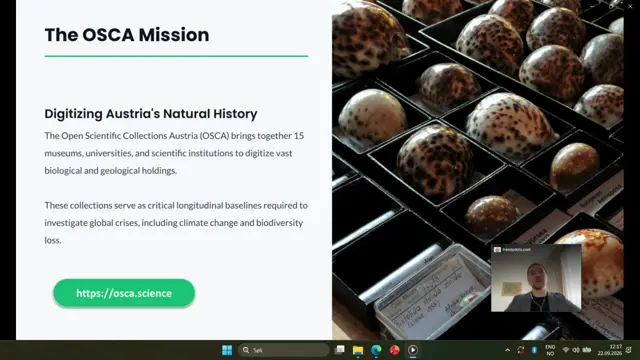
How Darwin Core enables harmonizing Biodiversity Data via the OSCA Consortium
A shared Darwin Core-based cloud pipeline lets 15 Austrian institutions of very different IT capacity publish harmonised specimen data.
Metadata matters: perceptions on the implementation of Darwin Core in the biocollections cyberinfrastructure
Standardisation through Darwin Core can mask nuance, and practitioners report complex data, missing guidelines and limited capacity as the main implementation barriers.
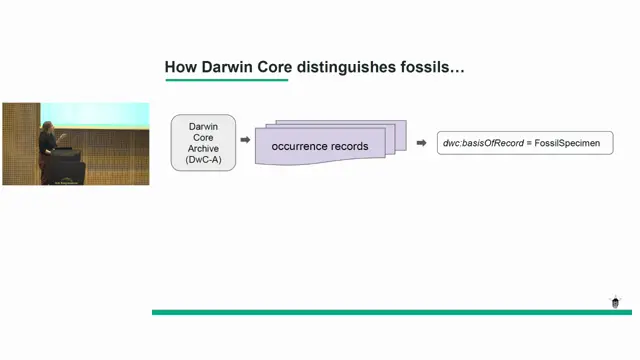
A community-curated controlled vocabulary for fossil collections using dwc:materialEntityType
A granular, community-derived vocabulary for dwc:materialEntityType would let users filter fossil records by what the material actually is, which basisOfRecord cannot do.