
Confronting legacy data for primary type specimens
Cailin Meyer · From Cabinets to Clouds - Bridging the gap between collection- and database management
The short versionDecades of database migrations left the second-largest insect collection's type catalogue unreliable, and only a full physical inventory is fixing it.
What this was about
The presenter traced the USNM Entomology primary type catalogue through handwritten ledgers (since 1896), the in-house INQUIRE type database (1980s), CRIS (mid-1990s) and EMu (migration 2007, full use by 2011). Poor field mapping from INQUIRE meant every migrated type record carried a public disclaimer as an 'INQUIRE type'. Migrated CRIS transaction records lacked objects and had odd dates. Barcodes were duplicated, and some types were never catalogued or linked to acquisitions. The department launched a multi-year, 100% specimen-level type inventory: curators compare EMu spreadsheets with specimens, and transaction discrepancies are resolved against paper records.
Why it matters. The talk is a frank case study of how legacy migrations degrade data and what a sustained, phased remediation looks like. Collections facing similar INQUIRE/CRIS/EMu-style histories can learn from it.
In the room
- The USNM Insect Collection (est. 1881) holds about 35 million specimens, over 400,000 species and over 130,000 primary types, with a small staff.
- Type ledgers in use since 1896 recorded catalogue number, name, sex, locality, year, sender, collector and entry date.
- INQUIRE (1980s, in-house) was kept separate from CRIS; both were migrated to EMu in 2007, and INQUIRE fields mapped badly.
- All migrated INQUIRE records carry a disclaimer until reviewed; a 'complete' record needs review, a USNM ENT barcode and an image.
- Other problems: uncatalogued types, duplicate barcodes from an external printer, and workflow gaps leaving acquisitions unlinked.
- Phase 1: curators check EMu spreadsheets against specimens. Phase 2: transaction linking and loan matching. Phase 3: vetting INQUIRE data and type citations. Phase 4: imaging.
- Progress: almost 3,500 existing type records completed and over 500 new types added.
Notable moments
Transcript
Automatically generated captions can contain mistakes, especially in names and technical terms. Times are relative to the room recording.
Read the transcript ↓
Related talks.
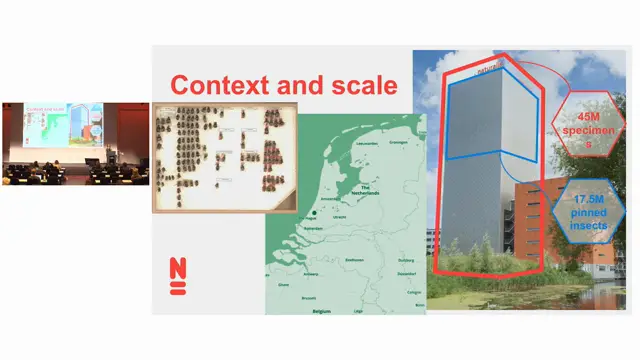
Managing high-volume specimen movements in the entomological collection of Naturalis with a new type of record
A 'lot' record linking taxa to storage units makes high-volume physical moves cheap to record and tells staff where each taxon is.
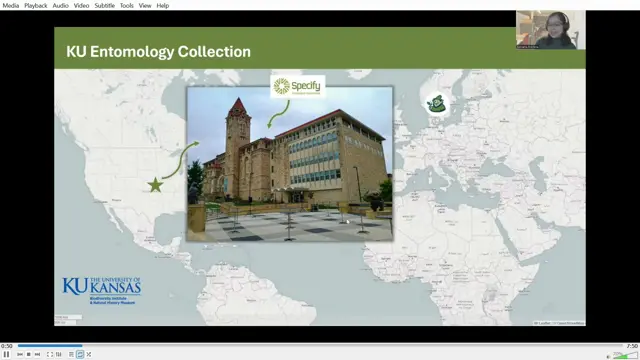
Updates on Data Mobilization in the KU Entomology Collection
Moving to Specify 7 with a nightly Darwin Core archive feed made KU Entomology's data and images continuously available to GBIF, Symbiota portals and students.
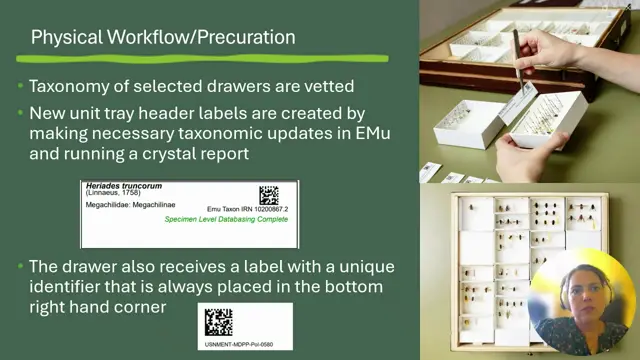
Pinned insect digitization conveyor: image and data transcription workflows
An industrial conveyor workflow with QR-encoded metadata and automated skeletal records makes mass digitisation of pinned insects feasible.