
Material Samples and Occurrences in Darwin Core Data Packages: Practical Experiences from DINA
Jonas Grieb · Solutions for Research Collection Management Systems Challenges
The short versionDINA's material-sample model maps well to DwC-DP, so DINA wants to publish without synthetic occurrences and needs community conventions for consumers to derive them.
What this was about
Jonas Grieb asked whether the Darwin Core conceptual model and DwC-DP fix a long-standing problem: CMSs that only hold material and event data have had to invent occurrences to publish to GBIF, producing unstable occurrence IDs. The DINA data model represents material object histories as material samples linked by processes and to collecting events, with organisms carrying determinations. Two worked examples showed good fit. A bat specimen, tissue and molecular extract chain maps to derivedFrom relationships. A mud shrimp and clam preserved together map to partOf relationships, though organism sex and life stage have no place on Material without creating an Occurrence. DINA therefore aims to publish DwC-DP without occurrences and let consumers such as GBIF derive them, which needs agreed conventions.
Why it matters. It tests in practice whether DwC-DP ends the 'material entities are not occurrences' problem, and pinpoints the remaining gap (sex and life stage on material) and a governance question for GBIF.
In the room
- A large share of GBIF records have material-entity bases of record (preserved, fossil specimens, material samples).
- Generating occurrences from material data causes unstable identifiers and incomplete events.
- DINA (consortium since 2014, governed by an MOU) models material samples, processes (collecting, subsampling, extraction) and organisms with determinations.
- Derivation chains map cleanly to MaterialEntity with derivedFromMaterialEntity; open question whether only the parent needs an event link.
- Mixed-organism samples map to partOf relationships, with some semantic blurriness.
- Sex and life stage cannot be placed on Material; options are a synthetic Occurrence (not favoured), non-schema fields, or Material Assertions (discoverability concerns).
- DINA plans to publish DwC-DP without occurrences.
Notable moments
Transcript
Automatically generated captions can contain mistakes, especially in names and technical terms. Times are relative to the room recording.
Read the transcript ↓
Related talks.
From Specimens to Networks: Darwin Core Data Packages in Practice
The Darwin Core conceptual model and Data Package give material entities a rich, relational context that flat Darwin Core Archives could not express.
Aligning An Evolving Global Data Model To Software With Global Ambitions: GBIF x TaxonWorks
TaxonWorks and DwC-DP have converged conceptually, but exchange between rich models will always be lossy, so mappings should be recorded explicitly.
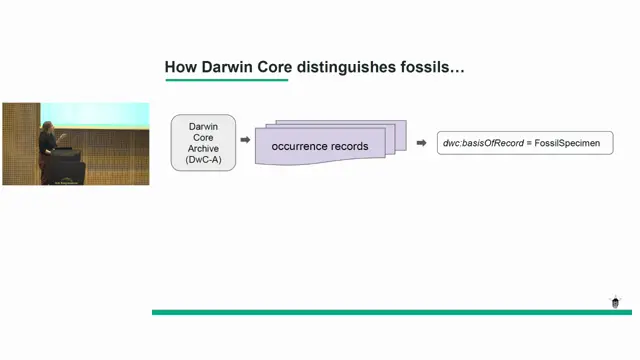
A community-curated controlled vocabulary for fossil collections using dwc:materialEntityType
A granular, community-derived vocabulary for dwc:materialEntityType would let users filter fossil records by what the material actually is, which basisOfRecord cannot do.