
From Specimens to Networks: Darwin Core Data Packages in Practice
John Wieczorek · Solutions for Research Collection Management Systems Challenges
The short versionThe Darwin Core conceptual model and Data Package give material entities a rich, relational context that flat Darwin Core Archives could not express.
What this was about
John Wieczorek explained that Darwin Core has moved from a 'bag of terms' to a standard with a conceptual model defining relationships between classes, focusing on MaterialEntity. Material entities can be part of or derived from other material entities. They take part in collection, sampling and derivation events, serve as evidence for occurrences and identifications, and connect to geological context and chronometric age. They can also underpin nucleotide analyses and sequences. Agents, media, assertions, identifiers, references, provenance, protocols and usage policies attach to classes via role and link tables. He closed by demonstrating the Darwin Core Data Package Designer, which generates a datapackage.json from selected tables.
Why it matters. It is the foundational explanation of DwC-DP semantics that several later talks in the session mapped against. The Designer tool offers a practical starting point for mapping CMS data.
In the room
- Darwin Core was a 'bag of terms'; the conceptual model now adds semantics at the level of classes as part of the standard.
- MaterialEntity: identifiable, persists for some time, consists wholly or partly of physical matter (organism, part, non-biological material, environmental sample).
- Two self-referential relationships: part of (physically connected) and derived from (no longer connected).
- Material entities take part in collecting, sampling and derivation (lab) events, and are evidence for occurrences and identifications.
- Geological context and chronometric age separate today's collecting event from the inferred past occurrence.
- Molecular data: material (even used-up material) is the basis for nucleotide analyses and sequences.
- Agents (people, institutions, software/AI) link via role tables; media link via material-media and event-media tables; assertions generalise measurements or facts.
Notable moments
Transcript
Automatically generated captions can contain mistakes, especially in names and technical terms. Times are relative to the room recording.
Read the transcript ↓
Related talks.
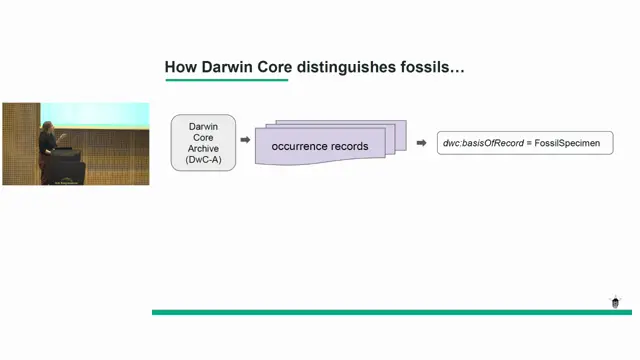
A community-curated controlled vocabulary for fossil collections using dwc:materialEntityType
A granular, community-derived vocabulary for dwc:materialEntityType would let users filter fossil records by what the material actually is, which basisOfRecord cannot do.
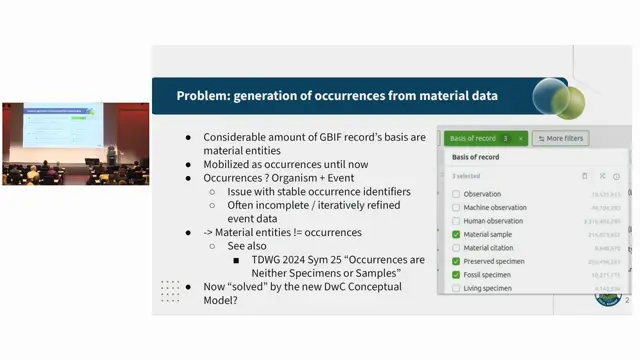
Material Samples and Occurrences in Darwin Core Data Packages: Practical Experiences from DINA
DINA's material-sample model maps well to DwC-DP, so DINA wants to publish without synthetic occurrences and needs community conventions for consumers to derive them.
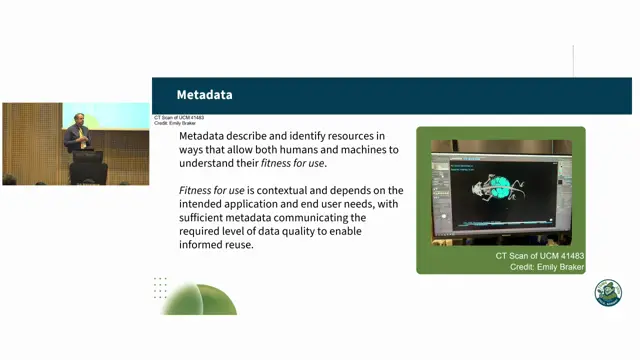
Metadata matters: perceptions on the implementation of Darwin Core in the biocollections cyberinfrastructure
Standardisation through Darwin Core can mask nuance, and practitioners report complex data, missing guidelines and limited capacity as the main implementation barriers.