
Explore the conversation.
Address from the TDWG Chair: highlights of the year and TDWG at a crossroads
TDWG has had a productive year, but a growing, more diverse community and the rise of AI put it at a crossroads that needs more volunteers, better documentation and more sustainable maintenance and funding.
David Bloom ↗
Biological occurrence data from historic scientific correspondence: enabling automated approaches for structured data extraction from body text
A Darwin Core-aligned annotated corpus from MfN journals provides a reference for evaluating automated occurrence extraction from historical texts.
Christian Bölling ↗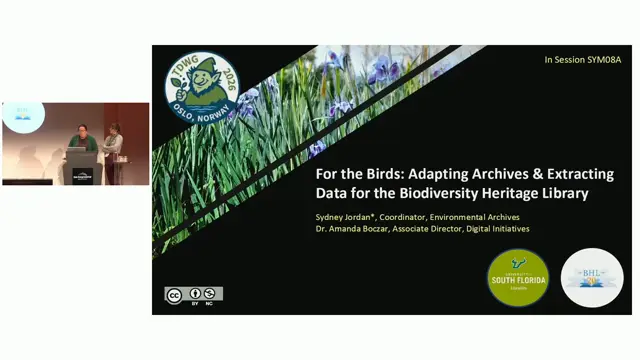
For the Birds: Adapting Archives and Extracting Data for the Biodiversity Heritage Library
USF is strengthening BHL's infrastructure via a redundant Macaw ingest instance while working to bring vulnerable Florida environmental archives and their data into BHL.
Amanda Boczar, Sydney Jordan ↗
Geonomia: Metadata and Community for Georeferencing
Clustering specimens into collecting trips makes georeferencing and AI enrichment more efficient and should be done as a community effort.
Nicky Nicolson ↗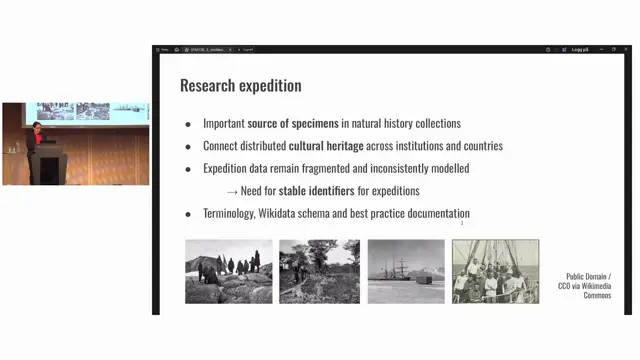
Here, There, and Everywhere: Modelling Research Expeditions in Wikidata
Treat research expeditions as first-class entities with Wikidata identifiers so distributed specimens, people, publications and archives can be linked.
Sabine von Mering ↗
Multimodality for Knowledge Extraction from Historical Entomology Literature
Aligning text and illustrations in a multimodal knowledge graph can generate evidence-grounded captions and recover knowledge lost by text-only extraction.
Jana Hoffmann, Sefika Efeoglu ↗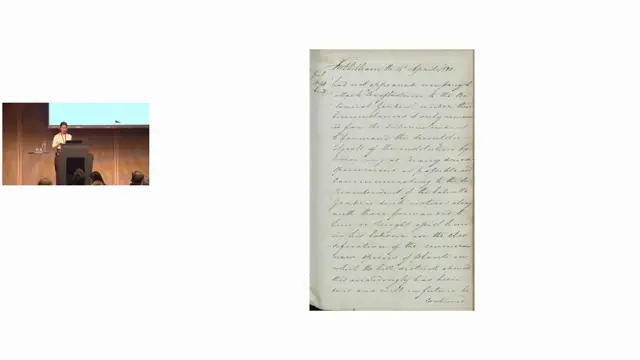
Rediscovering Archives - Using LLM's for the Transcription and Extraction of Ecological Data from Historical Archives
Off-the-shelf multimodal LLMs can transcribe varied handwritten archives well, with closed models more robust on structured tables.
Phoebe Santos ↗
SYM08B discussion: extracting geography and articles from BHL
Article-level discoverability and geographic extraction are key BHL gaps that AI may now make tractable, but resourcing remains the constraint.
Nicole Kearney, Roderic Page ↗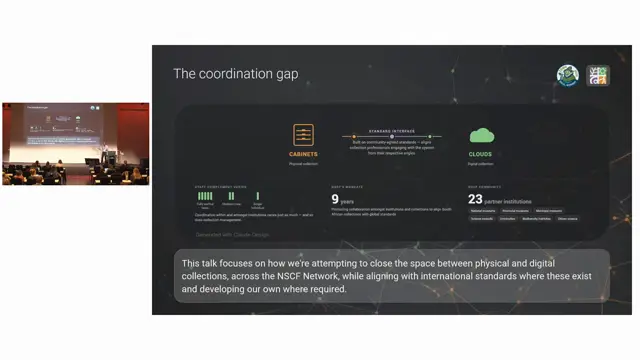
From Silos to Standards - Advancing Standardised Collection State Documentation for Institutional Continuity and Coordination
Standardising how collection state (readiness, risk, conditions) is recorded turns tacit curatorial knowledge into shared, comparable institutional memory.
Jacobus Christiaan Steenkamp ↗
SYM29A panel discussion: working with collection managers, documentation and institutional strategy
Bridging cabinets and clouds depends on people: engaging collection managers, making data work visible, institutional strategy and durable documentation.
Caitlin Thorn, Jacobus Christiaan Steenkamp, Cailin Meyer ↗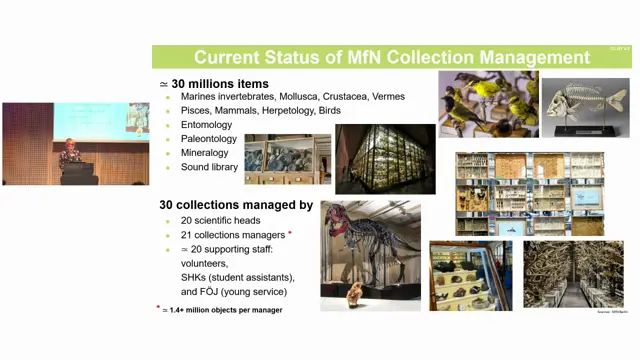
The Good, the Bad, and the Standardised: A Specify Journey Through 200 Years of the MfN Berlin's Biological Collections
Specify's flexibility lets MfN consolidate 30 historically complex collections into one database while starting to reconstruct colonial and wartime history, but geography and historical events remain unsolved.
Marion Depraetere ↗