
From Pixels to Policy: Closing the Gap between In Situ Monitoring, Earth Observation, and Policy Actionability
Claus Weiland · Building resilient data infrastructures for biodiversity science
The short versionPackaging data with its semantics, provenance and machine-readable policy as FAIR Digital Objects makes it rescue-ready and redeployable elsewhere.
What this was about
Claus Weiland presents a "Pixel to Policy" approach for making endangered earth and environmental data rescue-ready, within the new DFG-funded SEND Earth Data project that aims at preservation workflows with legal guidance, resilient storage and a national data-sovereignty network grounded in NFDI4Earth and aligned with the AGU global data resilience framework. Use cases include camera-trap data from Polissya (Ukraine) with the Frankfurt Zoological Society, multidisciplinary monitoring from Socotra (Yemen), and redundant storage for Movebank tracking data. Data, annotations, Earth-observation links, machine-readable policies and workflow provenance are packaged as FAIR Digital Objects built on web standards (schema.org, RO-Crate, Bioschemas, Croissant) - "WebFDO" - with a Wildlife Monitoring Ontology and ODRL-based policy objects serving as "data lifeboats".
Why it matters. It offers a concrete technical pattern for moving at-risk biodiversity and environmental data between infrastructures without losing the legal and policy context that makes it usable.
In the room
- Data at risk from institutional defunding, reprioritization toward security and AI, and armed conflict.
- SEND Earth Data (Secure Endangered Earth Data), DFG-funded and started two months ago, delivers preservation workflows with legal guidance and usage agreements, resilient storage and a national data-sovereignty network grounded in NFDI4Earth.
- Use cases: Polissya camera traps (Ukraine, with Frankfurt Zoological Society), Socotra monitoring (Yemen, with the Royal Society for the Conservation of Nature, Jordan), redundant storage for Movebank.
- A capture event links images, ML annotations, DNA from samples, Earth-observation time series, machine-readable policies, licences and workflow provenance; drawing a software "box" around it with an identifier and type makes a FAIR Digital Object.
- WebFDO uses schema.org/JSON-LD, RO-Crate, Bioschemas and MLCommons Croissant; DiSSCo digital specimens are the same concept.
- Wildlife Monitoring Ontology (WLMO), derived from SOSA, with mappings to Camtrap DP via SSSOM.
- Policy embedded with ODRL permissions and duties and the European Legislation Identifier ontology (from Biodiversity Meets Data), e.g. linking to the Nature Restoration Law.
Notable moments
Transcript
Automatically generated captions can contain mistakes, especially in names and technical terms. Times are relative to the room recording.
Read the transcript ↓
Related talks.
The WildLIVE Portal: Towards Scalable Wildlife Monitoring through the Integration of Citizen Science and Human-in-the-Loop AI Workflows
WildLIVE combines a model registry, provenance-tracked human verification and FAIR publication to move camera trap data from raw images to publishable data.
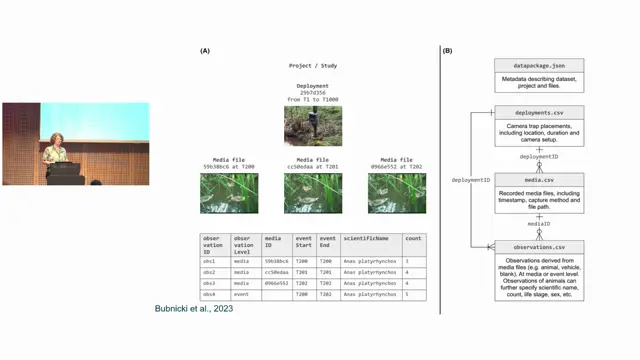
Camtrap DP: extending data standard designed for camera trapping research to support AI workflows and new data sources
Camtrap DP fits data from any stationary sensor, and converging community feedback shows how to extend it for AI provenance and multimodal monitoring.
Supporting resilient data infrastructure in a changing environment
Technical copies are not enough: durable data infrastructure depends on preserved human expertise, messy maintenance work and data standardized close to collection.