
Explore the conversation.
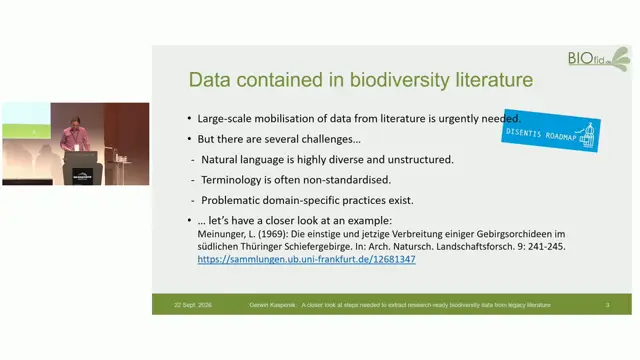
A closer look at steps needed to extract research-ready biodiversity data from legacy literature
Legacy literature data can only be unlocked by combining better OCR/NLP with taxonomic rigour that accounts for synonymy, shifting concepts, coreference and mixed languages.
Gerwin Kasperek ↗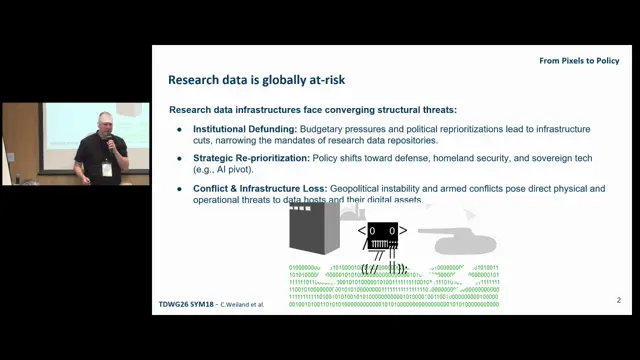
From Pixels to Policy: Closing the Gap between In Situ Monitoring, Earth Observation, and Policy Actionability
Packaging data with its semantics, provenance and machine-readable policy as FAIR Digital Objects makes it rescue-ready and redeployable elsewhere.
Claus Weiland ↗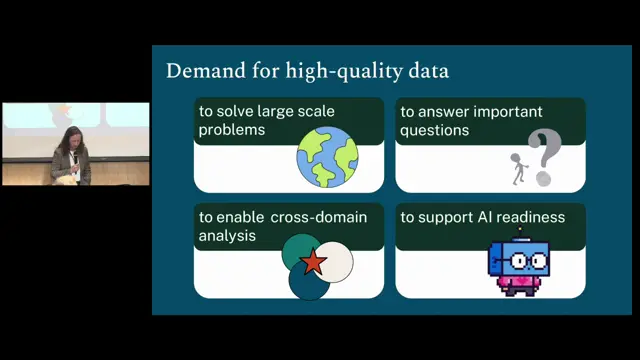
Supporting resilient data infrastructure in a changing environment
Technical copies are not enough: durable data infrastructure depends on preserved human expertise, messy maintenance work and data standardized close to collection.
Rachael Blake ↗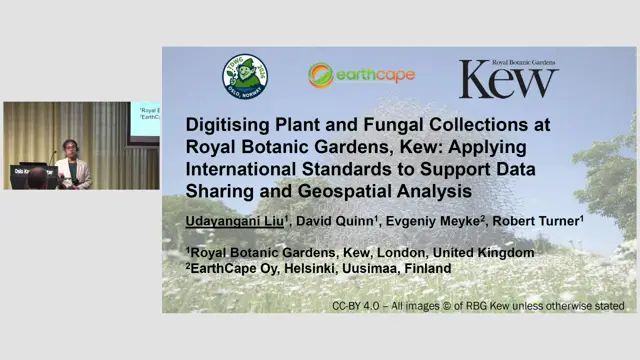
Digitising Plant and Fungal Collections at Royal Botanic Gardens, Kew: Applying International Standards to Support Data Sharing and Geospatial Analysis
WGSRPD enables cross-collection geospatial analysis at Kew, but historical, heterogeneous data leave half of records without fine-level assignment.
Udayangani Liu ↗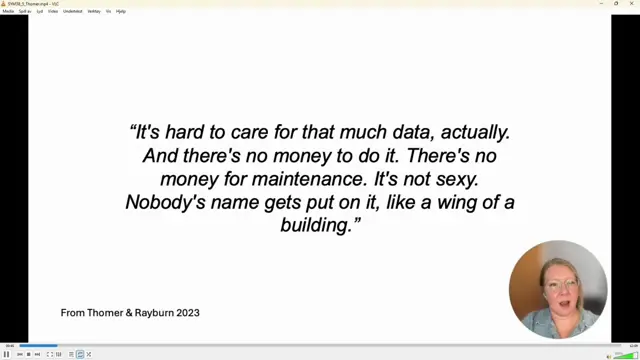
From preservation to perseverance: bridging disciplines for data resilience
Data resilience in a crisis is about prioritisation and mutual aid rather than perfection, and infrastructures need to be kept appropriately visible to be funded.
Andrea Thomer ↗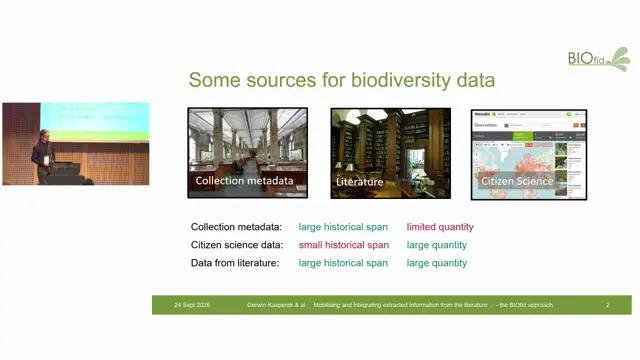
Mobilising and integrating extracted information from the literature into a biodiversity data ecosystem - the BIOfid approach
BIOfid mobilises Central European biodiversity literature with NLP, ontologies and standards, because raw LLM extraction still hallucinates identifiers and needs verification.
Gerwin Kasperek ↗
Extracting Structured Biodiversity Knowledge from Literature with AI-Assisted Workflows
A hybrid text-layer/OCR tool can free tables from grey-literature PDFs into CSV with about 83% precision, but it misses a third of tables, especially narrow ones.
Yağmur Güleç ↗