
Explore the conversation.
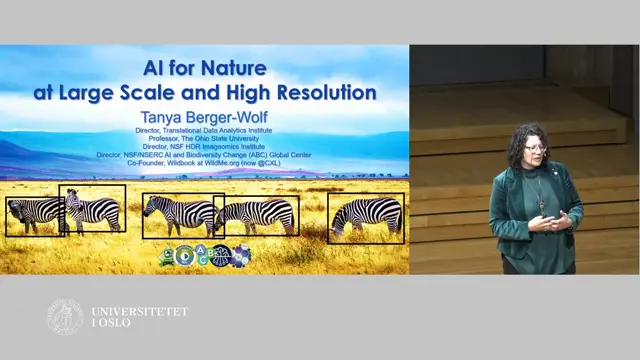
AI for Nature at Large Scale and High Resolution
AI can help fill biodiversity knowledge shortfalls only if biological knowledge is built into the models and the data infrastructure is FAIR for AI and returns value to primary data collectors, because 'there is no AI without data'.
Tanya Berger-Wolf ↗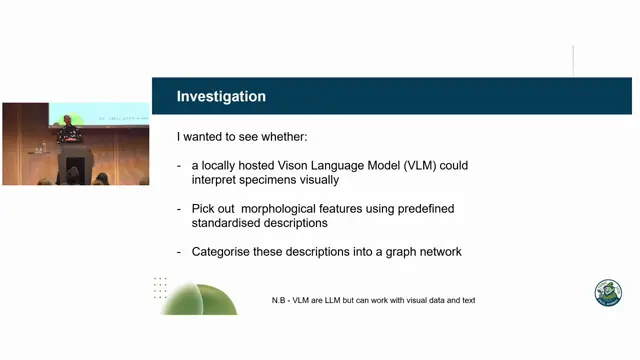
Agentic AI Systems for Specimen Interaction and Camera-Based Observation
Off-the-shelf local vision language models can pick out and count specimen morphology and spot damage with minimal guidance.
Jack Hollister ↗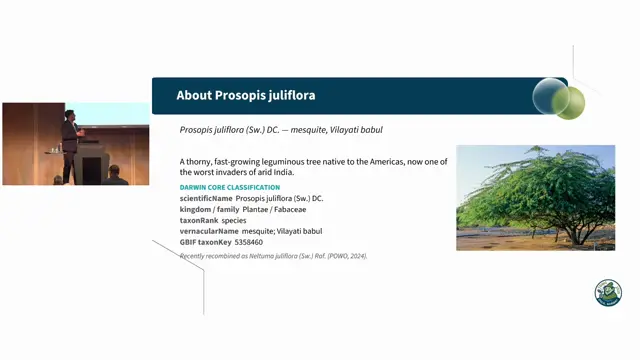
From satellite embeddings to Darwin Core: an open, ensemble-AI workflow for Prosopis juliflora mapping and reusable training-dataset generation
Satellite embeddings plus hyperspectral signatures and ground validation can map invasive Prosopis at scale and generate reusable, attributable training data.
Pranav Jha ↗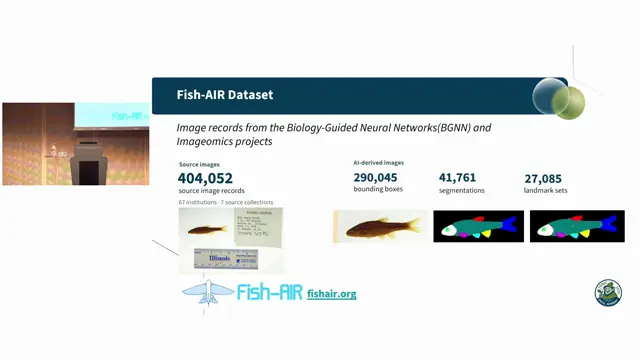
Provenance, Lineage, and Auditability in AI-Driven Biodiversity Image Workflows
Two persistent-identifier links per derived image, parent and batch, are enough to preserve auditable lineage and pipeline context for AI-processed biodiversity images, even outside the repository.
Xiaojun Wang ↗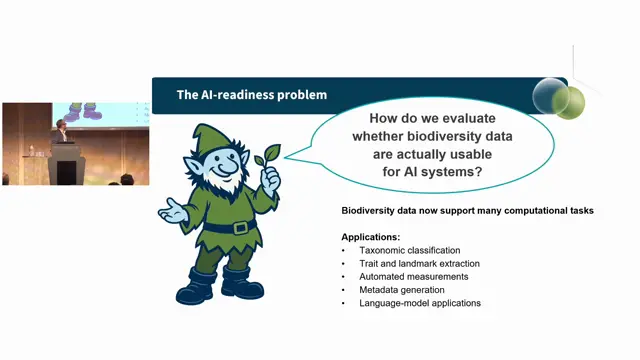
Toward Quantitative AI-Readiness Metrics for Biodiversity Data Infrastructures
AI readiness should be a task-specific, measurable profile rather than a single score, and current biodiversity standards lack most of the terms needed to describe it.
Yasin Bakış ↗
The Planetary Knowledge Base: an infinite solutions engine converting data into action for nature
The NHM is building the Planetary Knowledge Base in phases, with provenance, attribution and benefit-sharing designed in, to move biodiversity data to evidence to action at scale.
Vincent Smith ↗