
Mapping the Relational Data Schema of the Diversity Workbench (DWB) to the Darwin Core Data Package Data Model to fit better to GBIF´s New Data Model
Tanja Melanie Weibulat · Solutions for Research Collection Management Systems Challenges
The short versionDwC-DP promises to carry the relational richness that previously pushed GFBio centres to ABCD, and a first DWB-to-DwC-DP prototype via the test IPT works.
What this was about
Tanja Weibulat explained that GFBio data centres chose ABCD because early Darwin Core couldn't express DWB's complex relations. Their pipeline exports and filters DWB modules (withholding restricted data, anonymising people, rounding coordinates) into PostgreSQL, then maps to ABCD via BioCASe for GBIF and NFDI4Biodiversity. Limitations were that GBIF didn't display multiple identifiers, persons, roles or relations, and data papers needed manual entry. They prototyped mapping the same PostgreSQL tables to DwC-DP in a test IPT: observations and physical specimens split into Occurrence and Material, event, identification and agents shared, and analysis and processing combined into Material Assertion. Next steps are a GBIF sandbox comparison, metadata mapping and extending to the GFBio portal.
Why it matters. It is a concrete ABCD-to-DwC-DP transition test that matters for the many German data centres still publishing ABCD.
In the room
- DWB publishing used ABCD because Darwin Core was 'too slow' to capture relations.
- Pipeline: DWB modules → filtered export (withhold, anonymise, round coordinates) → PostgreSQL per data package → BioCASe → ABCD XML harvested by GBIF and NFDI4Biodiversity.
- GBIF did not display multiple global identifiers, persons with roles, or relations present in ABCD; data papers needed manual entry.
- Only a test version of the IPT currently supports DwC-DP; source tables were accessed directly via SQL.
- Mapping required splitting observation vs specimen data into Occurrence and Material and combining analysis/processing into Material Assertion.
- Dataset metadata must still be entered manually in the IPT.
Notable moments
Transcript
Automatically generated captions can contain mistakes, especially in names and technical terms. Times are relative to the room recording.
Read the transcript ↓
Related talks.
Aligning An Evolving Global Data Model To Software With Global Ambitions: GBIF x TaxonWorks
TaxonWorks and DwC-DP have converged conceptually, but exchange between rich models will always be lossy, so mappings should be recorded explicitly.
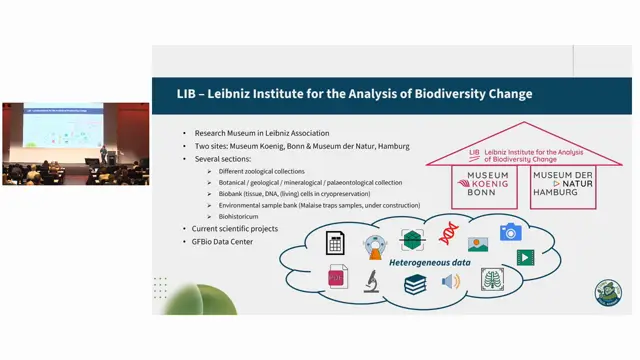
Diversity Workbench (DWB) as a Standards-Based Collection Management System for Heterogeneous Research Data and Biodiversity Data Mobilization
Diversity Workbench can hold very heterogeneous institutional data and publish it through standard pipelines, but its complexity pushes LIB to build web and API layers.
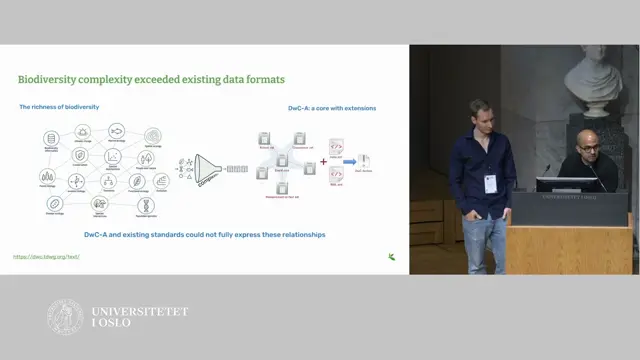
DwC-DP Integration at GBIF
GBIF is close to supporting Darwin Core Data Packages end to end, with typed and stricter validation, while keeping Darwin Core Archives fully supported.