
From Client to App: Extending Diversity Workbench with REST and graphical web interfaces
Björn Quast · Solutions for Research Collection Management Systems Challenges
The short versionA concept-based REST API and search index let LIB build flexible web interfaces and ingest data on top of the complex Diversity Workbench database.
What this was about
Björn Quast described work in progress to connect Diversity Workbench more directly with users. Currently the Windows-only client is organised by data concept and feels complex, and publishing pipelines transform data several times with no way back. LIB's online catalogue offers adjustable filters, suggestions, Boolean queries, table downloads and specimen pages with stable identifiers. A redesign aims at mobile-friendly visual exploration using an Elasticsearch index that respects DWB's multi-level access rights. A REST API with concept-based endpoints, sharing JSON structures with the index, supports variable user interfaces and constraint-based insert/update ingest rules. It is already used to ingest ASV registry data (OTU tables, occurrences, identifications).
Why it matters. It shows a path for legacy desktop CMSs to open up through APIs and web front ends, including data ingest from other systems.
In the room
- The DWB client is Windows-only and structured by data concept, which confuses users.
- Publication pipelines filter by access rights, project and collection through multiple format transformations, with no way back.
- The online catalogue offers adjustable filters, suggestions, Boolean sub-queries, CSV download and specimen pages with stable identifiers.
- Redesign goals: mobile-friendly, chart-based visual exploration backed by Elasticsearch with DWB's access rights.
- The REST API uses concept-level endpoints (e.g. four collection-event tables in one schema) sharing JSON with the index.
- Ingest rules (insert, update, insert-if-not-exists, attach) are decided via database-style constraints.
- The API is used to ingest ASV registry data into DWB.
Notable moments
Transcript
Automatically generated captions can contain mistakes, especially in names and technical terms. Times are relative to the room recording.
Read the transcript ↓
Related talks.
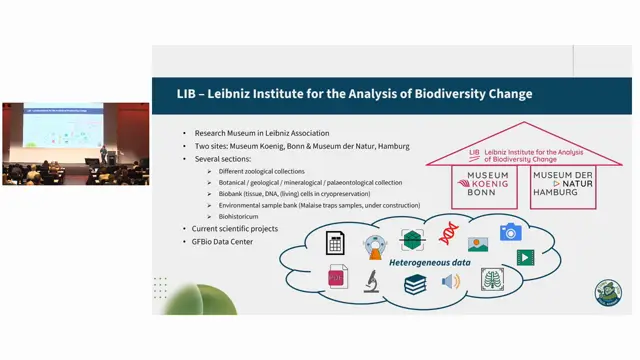
Diversity Workbench (DWB) as a Standards-Based Collection Management System for Heterogeneous Research Data and Biodiversity Data Mobilization
Diversity Workbench can hold very heterogeneous institutional data and publish it through standard pipelines, but its complexity pushes LIB to build web and API layers.
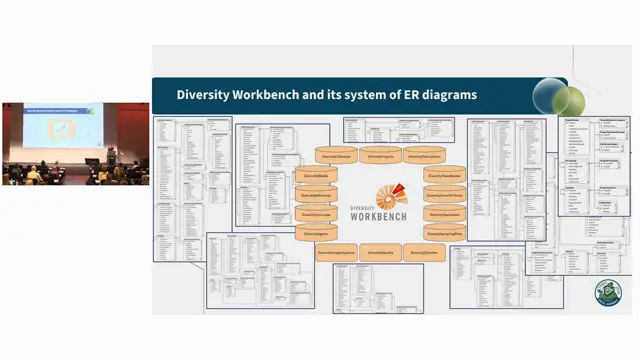
Mapping the Relational Data Schema of the Diversity Workbench (DWB) to the Darwin Core Data Package Data Model to fit better to GBIF´s New Data Model
DwC-DP promises to carry the relational richness that previously pushed GFBio centres to ABCD, and a first DWB-to-DwC-DP prototype via the test IPT works.
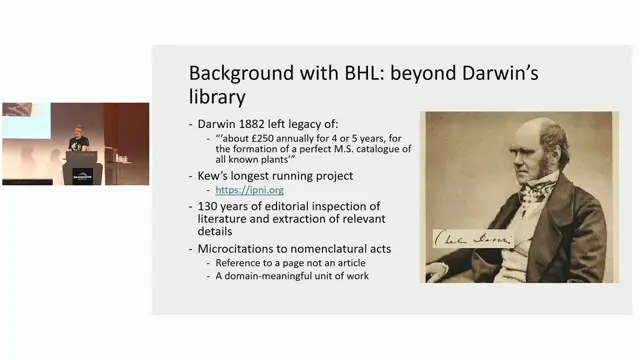
Possibilities to enhance the semantic navigation of BHL: further developing the 'unit of work'
Letting user communities carve BHL into branded, pre-filtered 'hosted portals' could serve diverse needs, satisfy funders and drive innovation.