
Symposium discussion: funding models, open data and sustaining biodiversity infrastructure
Libby Ellwood, James Macklin, André Zerger, José Fortes, Joe Miller, Chandra Earl, Mirella, Deb · Sustaining the Geo- and Biodiversity Data Ecosystem: Standards-Driven Approaches to Long-Term Resilience
The short versionThe community broadly agreed that core data should stay open, but that products, services, credits, regulation and partnerships must become part of sustaining the infrastructure.
What this was about
The discussion centred on José Fortes's proposal for economically aware infrastructure. Andre Zerger (ALA) described shared-cost models in research infrastructure and asked for exemplars; Joe Miller warned that institutions charging for data could collapse global aggregation and pointed instead to biodiversity credits and a New Zealand pilot; Chandra Earl suggested banking and medical informatics as governed parallels. Further threads covered a Spotify-style payout model to incentivise publishing, large-scale storage (look to astronomers), whether science infrastructure should be publicly funded like roads and water, regulation requiring private sector data sharing (Colombia, France), outsourcing IT to the cloud, and inviting economists and social scientists into these conversations.
Why it matters. It surfaces the key tensions in funding biodiversity infrastructure (open data vs. cost recovery, public vs. market funding) and concrete alternatives being tried.
In the room
- Charging for data at individual institutions risks collapsing global aggregation and citation tracking; products and services are more appropriate targets.
- Fortes: hybrid models need not eliminate free access; credit or virtual-currency schemes (as in US supercomputing) can preserve it, but commercial services such as LLMs will cost money.
- Around 70 countries are discussing biodiversity credit schemes; GBIF is piloting with New Zealand for nodes to act as data repositories for credit schemes.
- Banking standards are paid for through transaction fees; medical informatics is far more governed than biodiversity informatics.
- A Spotify-like payout model could incentivise publishing and good metadata for currently unshared data.
- Astronomers generate around 70 PB per month and are a source of storage solutions.
- Science infrastructure may be better treated like public infrastructure (water, power, roads) than market-driven.
Notable moments
Transcript
Automatically generated captions can contain mistakes, especially in names and technical terms. Times are relative to the room recording.
Read the transcript ↓
Related talks.
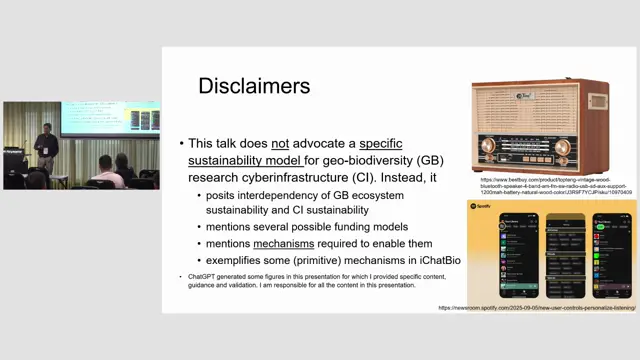
Requirements of Sustainability Models for Geo-Biodiversity Data Cyberinfrastructure
Cyberinfrastructure sustainability and ecosystem sustainability go hand in hand, so infrastructure must be designed from the start to track use and support economic orchestration.
Reconsidering the original vision for a global biodiversity information facility
GBIF achieved its 1999 vision only partially and through a network of collaborating infrastructures; the community must decide whether that is enough and articulate the next vision.
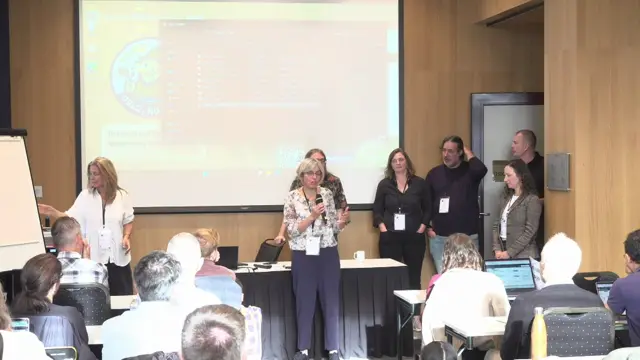
SYM18 discussion: who sustains biodiversity data infrastructures?
Volunteer and single-developer infrastructures deliver proven value, but the community lacks mechanisms and funding to protect them.