
Building a New Foundation for the Biodiversity Heritage Library
Nicole Kearney · Monday plenary programme
The short versionBHL has survived losing its Smithsonian home by becoming an independent, globally governed consortium, but its future is still not secure and it needs community support.
What this was about
Nicole Kearney told the story of how the Biodiversity Heritage Library (BHL) survived the Smithsonian's 2025 decision to stop hosting it from 1 January 2026. BHL moved its financial and legal home to the Council on Library and Information Resources (CLIR), the Field Museum took over web and technical hosting, and new members supplied technical support. Public fundraising now matters for the first time. She said BHL is only secure through 2027, described the platform modernisation now under way, and asked the community for partnerships and funding.
Why it matters. BHL is a core infrastructure for taxonomy and biodiversity knowledge, and its near-collapse shows how fragile long-running community infrastructures are when they depend on one institutional host.
In the room
- BHL is a consortium of 684 contributing organisations with more than 64 million freely accessible pages, full-text search and taxonomic name recognition.
- BHL has added article data to scholarly articles and assigned DOIs to more than 80,000 of them, including retrospective DOIs for historic species descriptions.
- In April 2025 the Smithsonian said it would stop hosting BHL (secretariat staff, technical team, seven servers and the website) from 1 January 2026.
- BHL moved to CLIR as its financial and legal home, which lets it accept donations, apply for grants and manage staff contracts on its own.
- New members stepped in: University of South Florida Libraries (three years of support for BHL's metadata collection workflow system), Vanderbilt University (an associate cloud engineer) and a third organisation (ASR 'Zenberg Nature Support', probably Senckenberg). The Field Museum now hosts the website and infrastructure; the move from Washington DC to Chicago finished at the end of June.
- BHL's July user survey put enhanced text search first, then image search and a better page viewer. These drive a platform modernisation towards a cloud-based, machine-actionable, linked-data platform with better APIs and persistent identifiers.
- Public fundraising: the Give BHL Wings campaign reached US$50,000 on New Year's Eve, a Guardian feature brought in more than US$10,000 in one day, and online donations have passed US$100,000 from more than 1,750 donors in 48 countries.
Notable moments
Transcript
Automatically generated captions can contain mistakes, especially in names and technical terms. Times are relative to the room recording.
Read the transcript ↓
Related talks.
Introduction: Reimagining BHL
BHL at 20 has a new independent foundation but an unsecured future, and the symposium seeks ideas to shape what comes next.
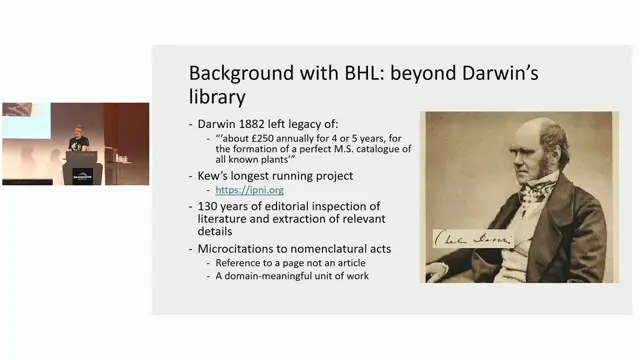
Possibilities to enhance the semantic navigation of BHL: further developing the 'unit of work'
Letting user communities carve BHL into branded, pre-filtered 'hosted portals' could serve diverse needs, satisfy funders and drive innovation.
Reconsidering the original vision for a global biodiversity information facility
GBIF achieved its 1999 vision only partially and through a network of collaborating infrastructures; the community must decide whether that is enough and articulate the next vision.