
Reconsidering the original vision for a global biodiversity information facility
Joe Miller · BHL at 20: A New Chapter for Biodiversity Literature and Data - Reimagining BHL: Foundations, Partnerships and Future Infrastructure
The short versionGBIF achieved its 1999 vision only partially and through a network of collaborating infrastructures; the community must decide whether that is enough and articulate the next vision.
What this was about
Joe Miller, GBIF Executive Secretary, offered a 'provocation' for GBIF's 25th anniversary: a personal timeline of biodiversity infrastructures (LTER, GenBank, TDWG, the 1992 Rio conventions, TreeBASE, Species 2000/Catalogue of Life, OBIS, GEO BON, BHL, EOL) leading to the 1999 OECD Megascience Forum recommendation for a Global Biodiversity Information Facility. He revisited the report's figure: GBIF was to encompass names, specimen data, a 'species bank' and biodiversity literature, but funders narrowed it to occurrence data and the nodes network, and other initiatives (Catalogue of Life, BHL, EOL) filled the gaps. Today's landscape achieves 'synergisms among existing investments' through collaboration, but he asked whether that is enough. The Q&A debated how to make the case for closer BHL-GBIF links: Miller said the community, not the Secretariat, must bring such a case to the Governing Board; Donat Agosti argued literature data are already integrated at scale; and a commenter called for a new, AI-informed, impact-focused community vision.
Why it matters. It reframes the relationship between GBIF, BHL and related infrastructures as an unfinished design question, relevant to their sustainability and future integration.
In the room
- The 1999 OECD report proposed a distributed system of interlinked, interoperable databases and tools.
- Original content areas: catalogue of names, specimen data, species bank, biodiversity literature, linked to sequence, geospatial, climate and ecological data.
- Limited funding narrowed GBIF's scope to occurrence data and the nodes network.
- GBIF now has 70 member nations and around 300 businesses sharing data.
- Catalogue of Life collaboration ended duplication and benefits both organisations.
- New paper 'GBIF After 25 Years' published in Biodiversity Data Journal (Pensoft).
- Donat Agosti: 62,000 GBIF datasets derive from literature; new Pensoft/EJT publications reach GBIF within 24 hours with material citations linked to text positions.
Notable moments
Transcript
Automatically generated captions can contain mistakes, especially in names and technical terms. Times are relative to the room recording.
Read the transcript ↓
Related talks.
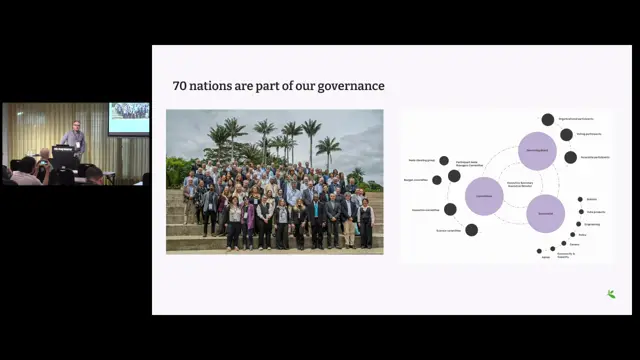
GBIF after 25 years
GBIF sustains itself by leveraging stable national contributions into additional funding and by embedding itself in the biodiversity policy and funding architecture.

Symposium discussion: funding models, open data and sustaining biodiversity infrastructure
The community broadly agreed that core data should stay open, but that products, services, credits, regulation and partnerships must become part of sustaining the infrastructure.
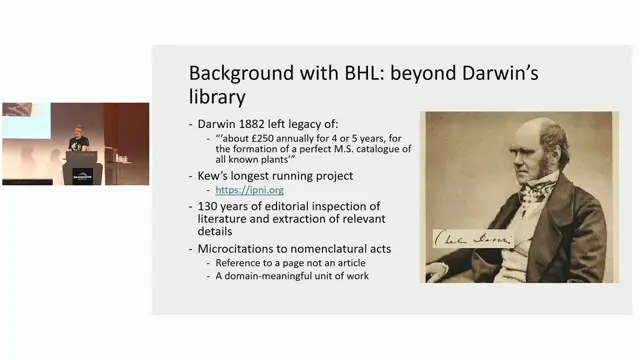
Possibilities to enhance the semantic navigation of BHL: further developing the 'unit of work'
Letting user communities carve BHL into branded, pre-filtered 'hosted portals' could serve diverse needs, satisfy funders and drive innovation.