
Semantic Governance and Knowledge Organization in AI-Augmented Biodiversity Infrastructures
Andrew Jones · Bots, Bits, and Biodiversity
The short versionAI-generated biodiversity knowledge must be provenance-aware and anchored in shared vocabularies, making AI-assisted rather than AI-directed curation.
What this was about
In a pre-recorded talk, Andrew Jones argued that as AI generates annotations, classifications and links probabilistically, the key question becomes how to govern the meaning AI creates. He identified challenges of semantic ambiguity, inconsistency, provenance and institutional trust, and proposed AI-assisted rather than AI-directed curation: outputs mapped to established vocabularies, checked against community standards and accompanied by provenance, with governance built into technical architecture. He called on TDWG to define provenance-aware, semantically transparent, interoperable and community-governed practices, pointing to the Image Quality and AI Readiness Task Group.
Why it matters. Articulates governance principles for AI annotations that complement technical frameworks like DiSSCo's validation layers.
In the room
- AI can enrich records, find relationships and improve discoverability, e.g. across Tulane's millions of specimen records.
- AI can generate an answer without generating an agreed-upon meaning.
- Challenges: semantic ambiguity, inconsistency between systems or runs, provenance of machine-generated content, institutional trust.
- Existing standards and vocabularies provide shared semantic commitments that generative AI lacks.
- AI-assisted curation: map outputs to vocabularies, check against standards, record provenance, note human review.
- Recommended principles: provenance-aware, semantically transparent, interoperable, community-driven governance.
Notable moments
Transcript
Automatically generated captions can contain mistakes, especially in names and technical terms. Times are relative to the room recording.
Read the transcript ↓
Related talks.
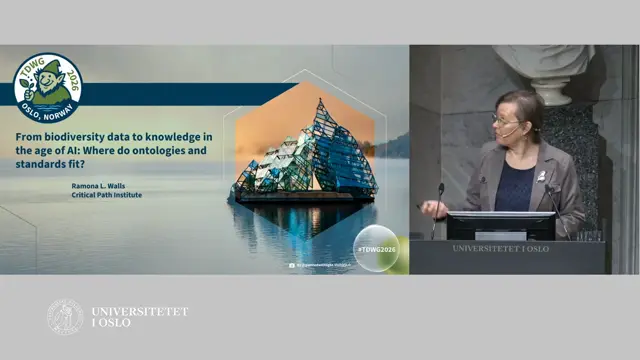
From biodiversity data to knowledge in the age of AI: where do ontologies and standards fit?
AI can generate data and candidate knowledge, but only standards, ontologies, provenance and governance let data become trusted evidence and therefore knowledge, which is why TDWG matters more than ever.
Discussion: designing institutional biodiversity knowledge and data science centres
Interoperable institutional knowledge spaces depend less on technology than on people, shared storage and semantics, incentives and governance.
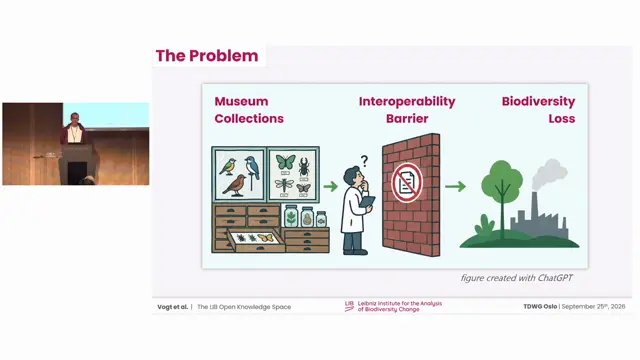
The LIB Open Knowledge Space: A semantic architecture for FAIR, CLEAR, and AI-ready biodiversity knowledge
Knowledge can enter the LIB Open Knowledge Space as natural language immediately and be formalised step by step, so content becomes FAIR, CLEAR and AI-ready incrementally.