
KakraCards: An AI-Assisted Pipeline for Liberating Six Decades of Seabird Heritage Data
Kristjan Adojaan · Bots, Bits, and Biodiversity
The short versionMulti-model consensus with human adjudication builds ground truth and picks the best LLM for transcribing standardised historical cards.
What this was about
Kristjan Adojaan described digitising about 9,000 catalogue cards recording nearly 60 years of breeding data for common gulls on a small islet in western Estonia. Scanned cards are sent simultaneously to several LLMs with a card-specific prompt; agreeing answers are accepted and disagreements resolved by a human, producing a ground truth used to benchmark more models (Gemini models performed best, Mistral among the worst) for about $50 over 3,000 decodings. Data will go into PlutoF and GBIF.
Why it matters. A cheap, replicable approach for liberating long-term ecological monitoring data held on paper.
In the room
- Monitoring on the islet (Kakrarahu) began in the 1960s; methodology changed little, so cards are consistent.
- Cards have a header, ringing data, yearly nest observations and handwritten recovery notes.
- Images are sent to several public LLMs; identical answers accepted, differences reviewed by humans, creating ground truth.
- Benchmarking more models: Gemini best, Mistral among the lowest; about $50 for 3,000 decodings; per-card-part effectiveness computed.
- Next: analyse confusion points, run on all ~9,000 cards, store in PlutoF and publish in GBIF.
Notable moments
Transcript
Automatically generated captions can contain mistakes, especially in names and technical terms. Times are relative to the room recording.
Read the transcript ↓
Related talks.
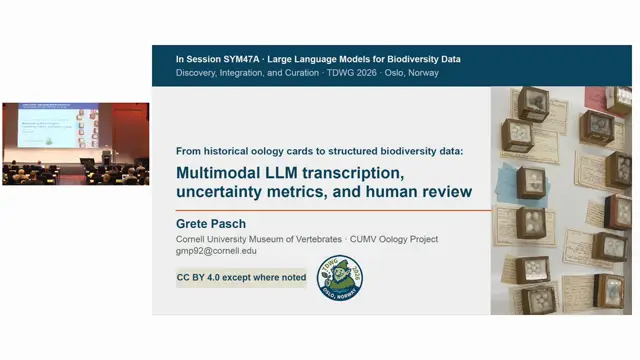
From Historical Oology Cards to Structured Biodiversity Data: Multimodal LLM Transcription, Uncertainty Metrics, and Human Review
Token-level hesitation from log-probabilities does not tell you which transcriptions are wrong, but it reliably predicts where human review effort will go.
From Images to Structured Data: A Scalable AI Workflow for Natural History Museums
A simple 'just do it' AI transcription pipeline with schema prompts, an intent step and full provenance can make label digitisation scale.
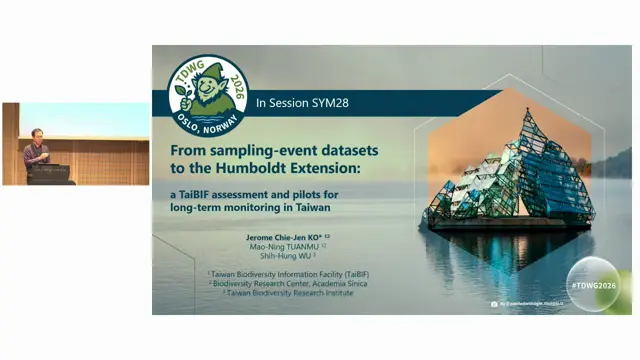
From sampling-event datasets to the Humboldt Extension: a TaiBIF assessment and pilots for long-term monitoring in Taiwan
Giving monitoring-data providers immediate site-level trend feedback, based on a minimal set of Humboldt terms, can motivate adoption better than asking for the full extension.