
Introduction to the AI for Biodiversity Data session: what machine learning and LLMs actually do
David Williamson · AI for Biodiversity Data
The short versionLLMs are word predictors with no notion of truth, so their outputs, including hallucinations, cannot be objectively scored from the text alone.
What this was about
David Williamson opened the SYM30A session with a primer on AI for a biodiversity audience: machine learning as approximating an unknown function y = f(x) from many labelled examples, illustrated with his own herbarium-sheet phenology classifier (buds, flowers, fruits). He then described large language models as next-token predictors trained on large text corpora, argued that 'reasoning' models only re-prompt themselves, and used examples completing 'Hymenoptera is a...' to argue that hallucinations are indistinguishable from true statements in the text and that there is no objective way to score such outputs. He closed by previewing the session's talks on machine vision, audio and validation.
Why it matters. It frames the whole session with a sceptical, mechanistic understanding of AI, reminding biodiversity researchers that performance measurement and truthfulness are open problems when using LLMs.
In the room
- Most talks in the session concern machine learning, specifically deep learning (neural networks, transformers, LLMs), a subfield of AI going back to the 1960s or earlier.
- Machine learning approximates an unknown function y = f(x) by training on many annotated examples, e.g. detecting buds, flowers and fruits on herbarium sheets.
- LLMs predict the next token given a system prompt, user prompt and conversation context; tool calls and 'reasoning' are bolt-ons or self-prompting.
- LLM performance is intuitively easy to judge but hard to measure objectively; they need huge training data and are expensive.
- Hallucinations are plausible sentences that may or may not be true; there is no way to tell from the text itself.
Notable moments
Transcript
Automatically generated captions can contain mistakes, especially in names and technical terms. Times are relative to the room recording.
Read the transcript ↓
Related talks.
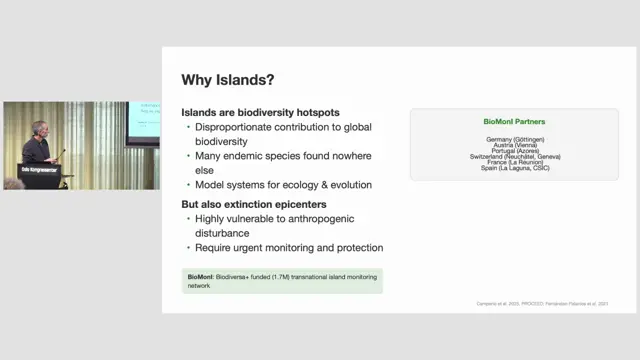
Literature triage to support Island Biodiversity Monitoring
Classifier-based literature triage matches human curators at a fraction of LLM cost and is worth investing in for recurring curation tasks.
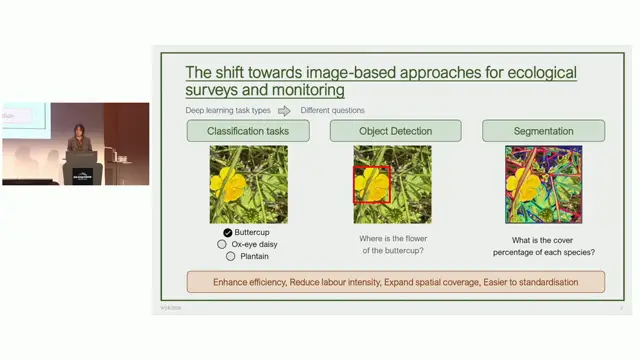
Are plant image datasets ready for AI-enabled community assessment? A systematic review of bias, representativeness and annotation quality
Current plant image datasets are not yet ready for AI-enabled ecological monitoring, especially for spatially explicit tasks and annotation quality.
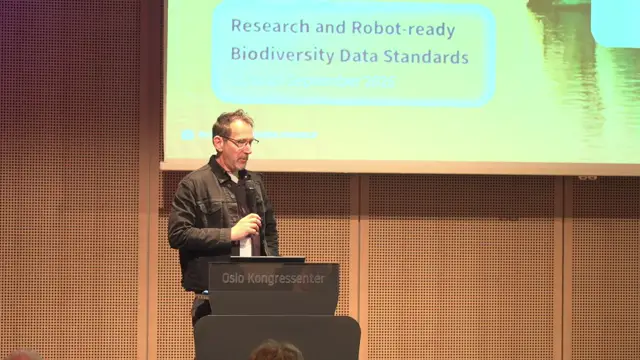
Panel discussion: From Mobilizing Data to AI-Ready Knowledge
AI-readiness is purpose-dependent, and the hardest remaining problems are social: trust, attribution, governance and data sovereignty, where ontologies and knowledge graphs offer some control and explainability.