
Explore the conversation.
From Images to Structured Data: A Scalable AI Workflow for Natural History Museums
A simple 'just do it' AI transcription pipeline with schema prompts, an intent step and full provenance can make label digitisation scale.
Anne Koivunen ↗
Open Digital Curation Needs: openness, interoperability, provenance
Open digital curation increases transparency, agency and trust and reduces latency, but needs new provenance practices for AI.
Deborah Paul ↗
Semantic Governance and Knowledge Organization in AI-Augmented Biodiversity Infrastructures
AI-generated biodiversity knowledge must be provenance-aware and anchored in shared vocabularies, making AI-assisted rather than AI-directed curation.
Andrew Jones ↗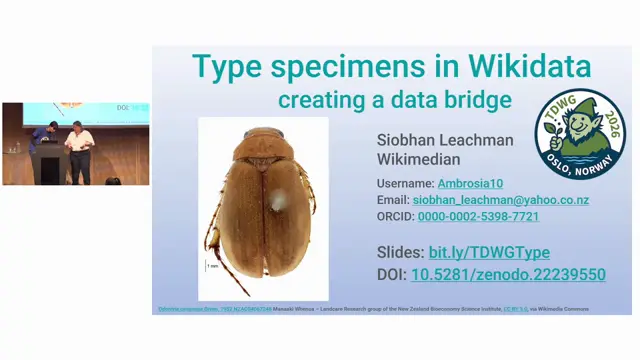
Type specimens in Wikidata
A consistent Wikidata type specimen model lets anyone link type specimens to collectors, publications, taxa and identifiers as a transparent finding aid.
Siobhan Leachman ↗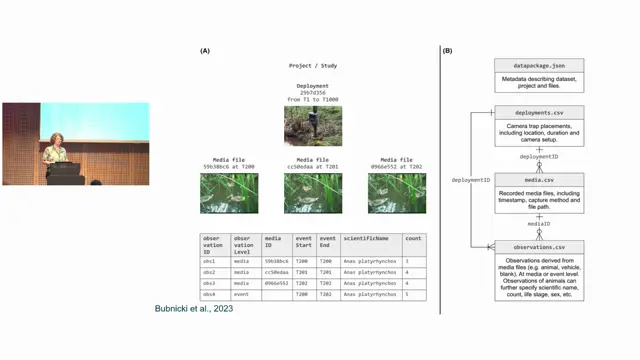
Camtrap DP: extending data standard designed for camera trapping research to support AI workflows and new data sources
Camtrap DP fits data from any stationary sensor, and converging community feedback shows how to extend it for AI provenance and multimodal monitoring.
Karolina Kuczkowska ↗
From Sensor to Species: AI-Assisted Segmentation, Deep Learning Workflows, and Persistent Biodiversity Records from Earth Observation Systems
Persistent organism identifiers for remotely sensed individual trees could turn repeat Earth-observation imagery into longitudinal biodiversity records, but only if uncertainty and model provenance travel with every record.
Kit Lewers ↗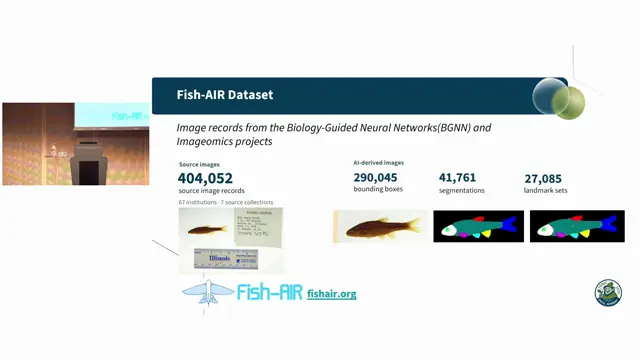
Provenance, Lineage, and Auditability in AI-Driven Biodiversity Image Workflows
Two persistent-identifier links per derived image, parent and batch, are enough to preserve auditable lineage and pipeline context for AI-processed biodiversity images, even outside the repository.
Xiaojun Wang ↗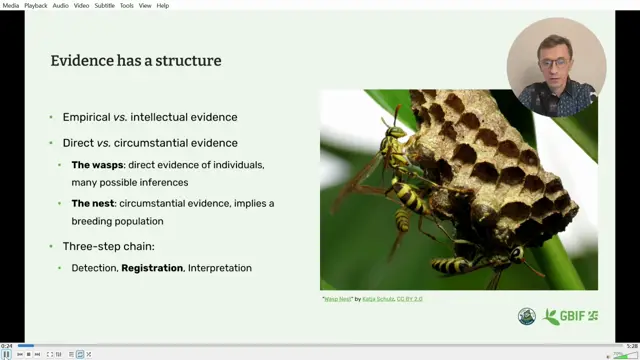
Handling evidence: a cross-disciplinary perspective
Biodiversity standards should stop treating what was recorded and what was concluded as the same kind of fact, borrowing evidence-handling practice from forensics, archaeology and medicine.
Dmitry Schigel ↗