
Type specimens in Wikidata
Siobhan Leachman · Responsible AI, Open Digital Curation, and Round-Tripping for Biodiversity Data
The short versionA consistent Wikidata type specimen model lets anyone link type specimens to collectors, publications, taxa and identifiers as a transparent finding aid.
What this was about
Siobhan Leachman presented a proposed Wikidata data model for type specimens, developed with Auckland Museum, Te Papa, the Bioeconomy Science Institute and Wikidata editors to fix inconsistent modelling. Wikidata is intended as a non-canonical finding aid bridging sources and identifiers, with references and edit history supporting transparent reuse by AI applications. The model was built from existing items, likely queries and a crosswalk to Darwin Core; new properties (collector, specimen classifier, collection date, location collected) were proposed, and a trial batch of New Zealand Arthropod Collection holotypes was uploaded via OpenRefine from GBIF data. Documentation is on a WikiProject, Wikimedia Commons and a Zenodo community; future work includes GBIF occurrence ID, basis of record, preservation method and biocultural notice properties.
Why it matters. Improves findability and interoperability of type specimens and gives AI applications a well-referenced, provenance-rich source.
In the room
- Motivation: inconsistent modelling of existing type specimen items; helping institutions translate Darwin Core data into Wikidata; supporting the digital extended specimen.
- Wikidata tracks references per statement and all edits, supporting transparency and provenance for AI reuse.
- Wikidata data are not canonical; they are a finding aid linking to the holding institution's data.
- Approach: compare existing items, review standards including Darwin Core, design for likely queries, be pragmatic for institutions already publishing to GBIF.
- New properties proposed for collector, specimen classifier, collection date and location collected.
- Trial batch: holotypes of the New Zealand Arthropod Collection extracted from GBIF, cleaned and reconciled in OpenRefine, uploaded to Wikidata.
- Documentation on a WikiProject, Wikimedia Commons and Zenodo (including the OpenRefine spreadsheet); exemplar items include a holotype first observed on iNaturalist and one linked to a DiSSCo DOI.
Notable moments
Transcript
Automatically generated captions can contain mistakes, especially in names and technical terms. Times are relative to the room recording.
Read the transcript ↓
Related talks.
Biological occurrence data from historic scientific correspondence: enabling automated approaches for structured data extraction from body text
A Darwin Core-aligned annotated corpus from MfN journals provides a reference for evaluating automated occurrence extraction from historical texts.
Bionomia, Scholia, Wikidata and Zenodo: broadcasting biodiversity data contributions
Linking people, specimens, publications, datasets and collections through Wikidata and associated tools (Bionomia, Scholia, Expeditia, Zenodo) makes biodiversity contributions findable and creditable.
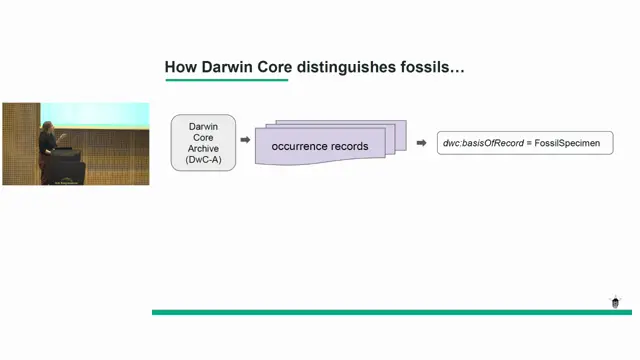
A community-curated controlled vocabulary for fossil collections using dwc:materialEntityType
A granular, community-derived vocabulary for dwc:materialEntityType would let users filter fossil records by what the material actually is, which basisOfRecord cannot do.