
A Network That Is Social: A Community-Based Model and Plan for Sustaining MorphoSource, a Scholarly 3D Data Repository
Julie Winchester · Publishing and Communications Promoting Biodiversity, Natural History Collections, People, Data and Data Standards
The short versionMorphoSource will sustain open access to 3D data by charging museums, journals, societies and depositors, never downloaders, as NSF funding ends.
What this was about
Julie Winchester presented MorphoSource, a Duke-hosted repository for 3D, 2D and AV media of scholarly objects, and its plan to move from NSF grant funding to a community-supported model. She summarised its scale (over a quarter of a million datasets, 96,000 specimens, 2,900 contributors, 32,000 users, about 3,000 citing articles) and running costs (about $400k/year staff plus $25k storage). The model combines voluntary user pledge drives, scholarly society sponsorships, tiered museum subscriptions for organisation-level management features (with a free tier), journal subscriptions and deposit fees, backstopped by Duke, with longer-term plans for shared infrastructure with the KU Biodiversity Institute.
Why it matters. It is a concrete, costed example of how a widely used community data infrastructure can shift to community funding without closing access, relevant to many biodiversity data services facing the end of grant funding.
In the room
- MorphoSource supports 3D meshes, point clouds, CT volumes, photogrammetry series, histology and video, with IIIF-based interactive previews and annotation tools.
- Launched in 2013 at Duke, supported by NSF grants since 2017; current funding runway ends toward the end of next year.
- Scale: over 250,000 datasets, 96,000 specimens from almost 2,000 collection organisations, 2,900 contributors, 32,000 registered users, over 25,000 taxa.
- Impact: over a million media downloaded since 2013, broad non-research use (schools, public, artists), at least 3,000 citing articles (about 640 in 2025), over 100 NSF abstracts mentioning it.
- In a survey of 750 respondents, MorphoSource was named as often as aggregated NCBI repositories as a data source.
- Costs: four FTE at about $400k/year plus $25k storage, rising $2,500/year; a steady state could run on about $300k.
- Revenue model: quarterly voluntary pledge drives (first in October), sponsorship from about 12 scholarly societies, four paid museum subscription tiers plus a free tier, journal subscriptions, and deposit fees; never charging for access or registration.
Notable moments
Transcript
Automatically generated captions can contain mistakes, especially in names and technical terms. Times are relative to the room recording.
Read the transcript ↓
Related talks.
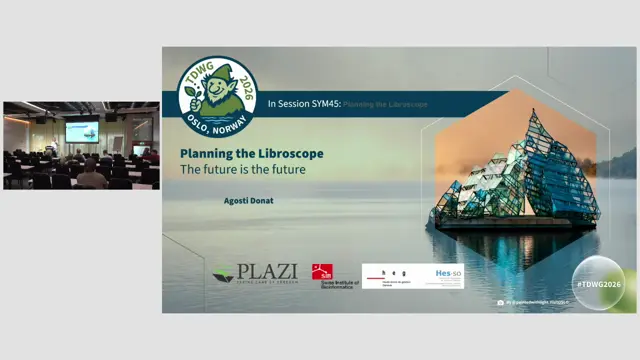
The future is the future - thought about access to data in publications
Liberating data from literature works, but the future lies in use-case-driven, digital-first publishing that also targets the undescribed majority of species.
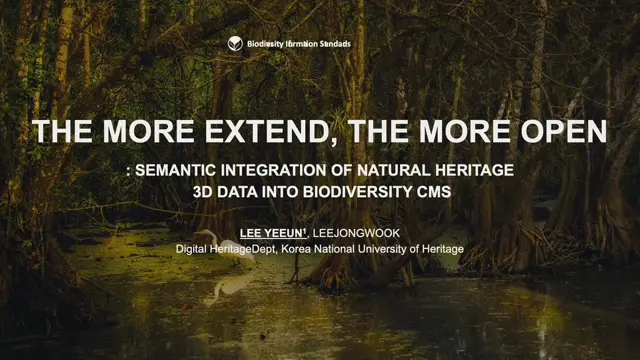
The More Extended, The More Open: Semantic Integration of 3D Natural Heritage Data into Biodiversity CMS
Treating 3D specimen models as entry points in a knowledge graph that includes heritage context and digitisation paradata makes them reusable knowledge assets.
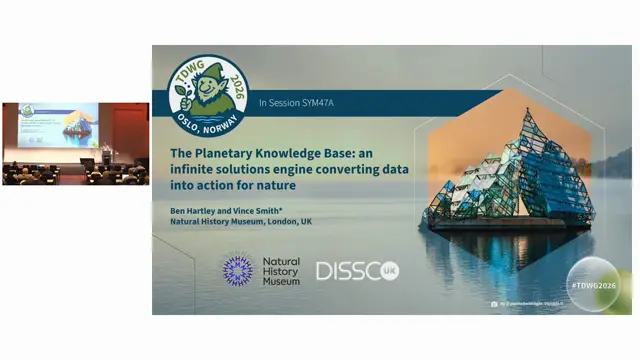
The Planetary Knowledge Base: an infinite solutions engine converting data into action for nature
The NHM is building the Planetary Knowledge Base in phases, with provenance, attribution and benefit-sharing designed in, to move biodiversity data to evidence to action at scale.