
National Biodiversity Information Action Campaign production process: a case study of Taiwan
Chun-I Chang, Jerome · National & Global Taxonomic Backbones
The short versionTaiwan's second national plan reframes biodiversity information infrastructure around resilience, with shared taxonomic references as a cornerstone of interoperability.
What this was about
Chun-I Chang described how Taiwan produced its 2026-2030 national Biodiversity Information Action Campaign, shifting from the 2021-2025 focus on building basic systems and data exchange to long-term resilience. The plan was co-developed via review, problem identification, a two-day workshop of a 10-person cross-institution working group mapping national data flows, and nine online meetings. Four vulnerabilities (governance, data flow, monitoring, sustainability) led to five directions including interoperability through shared taxonomic references; a 2025 data-gap campaign filled 852 grid cells and added over 3.8 million records.
Why it matters. Provides a replicable process for co-developing national biodiversity data strategies and a concrete example of mobilising partners to fill data gaps.
In the room
- 2021-2025 built basic database exchange and talent; 2026-2030 focuses on open data, integration and network building.
- Lessons: cross-domain collaboration is valuable, coordination takes time, participants have capacity constraints.
- Vulnerabilities identified: inter-agency governance, data flow, monitoring use, and sustainability (funding and people).
- Five directions: system interoperability (APIs plus shared taxonomic references), data openness and quality, network sustainability, inter-agency collaboration, data usability.
- The 2025 gap-filling action mapped geographic, temporal and taxonomic gaps and mobilised alliance partners.
- The alliance (16 government institutions under an MOU) is moving toward a formal organisation able to receive participant fees.
Notable moments
Transcript
Automatically generated captions can contain mistakes, especially in names and technical terms. Times are relative to the room recording.
Read the transcript ↓
Related talks.
The future is the future - thought about access to data in publications
Liberating data from literature works, but the future lies in use-case-driven, digital-first publishing that also targets the undescribed majority of species.
Reconsidering the original vision for a global biodiversity information facility
GBIF achieved its 1999 vision only partially and through a network of collaborating infrastructures; the community must decide whether that is enough and articulate the next vision.
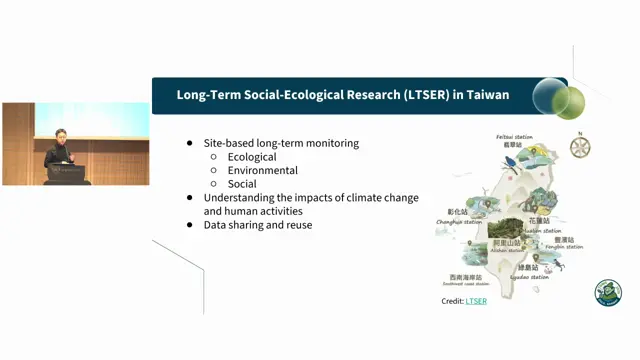
Building a Living Publication Workflow for Long-Term Social-Ecological Monitoring Data: The Taiwan LTSER Experience
Embedding Darwin Core alignment as automated checkpoints in a repository-based pipeline keeps continuously updated monitoring data flowing to GBIF.