
Transitivity Failures in Taxonomic Name Resolution: Implications for Botanical Dataset Construction
Adam Richard-Bollans · Data Quality: From Standard to Practice
The short versionAlways keep original verbatim names so datasets can be re-resolved against the latest taxonomy.
What this was about
Adam Richard-Bollans shows that resolving names to accepted names across taxonomy versions is not transitive: a name x resolved to y in one version may not resolve to where y resolves in a later version, e.g. because heterotypic synonyms are split. Comparing World Checklist of Vascular Plants versions (2022 vs 2025), about 13,000 of ~1.4 million names (≈1%) disagree, about half at species level, implying ~0.5% species-level error in datasets that kept only accepted names, rising to 0.7% by June 2026. Errors cluster in western and southern Europe (France, Italy, Spain).
Why it matters. Many secondary datasets discard original names after resolution; this quantifies the silent error that introduces and shows it grows over time.
In the room
- Most aggregated botanical datasets resolve names to accepted names and often discard verbatim names.
- Transitivity: x→y in v1 and y→z in v2 should imply x→z in v2; heterotypic synonym splits break this.
- Example: Panicum nitidum resolved to Dichanthelium dichotomum in WCVP v10 (2022), but to Dichanthelium nitidum in v14 (2025).
- ~13,000 of ~1.4 million names disagree (≈1%); about half at species level, some at genus level.
- Regional clustering of non-transitive resolutions in western/southern Europe.
- Error grows with time since the original version (0.5% in 2025 to 0.7% by June 2026 for a 2022 dataset).
- World Flora Online results are more severe; resolving to a different taxonomy likely increases error further.
Notable moments
Transcript
Automatically generated captions can contain mistakes, especially in names and technical terms. Times are relative to the room recording.
Read the transcript ↓
Related talks.
A knowledge organisation system for taxonomic data
Separating taxon data into layers with immutable taxon concepts at the centre gives a practical path to implementing TCS and fixing checklist quality problems.
From 'Lost in Translation' to Fit-for-Purpose Data: Why Ecologists and Conservation Practice Still Need Groupings and Uncertainties
Biodiversity data systems must be able to record identification uncertainty and taxonomic groupings, or ecologists face a choice between false certainty and lost ecological information.
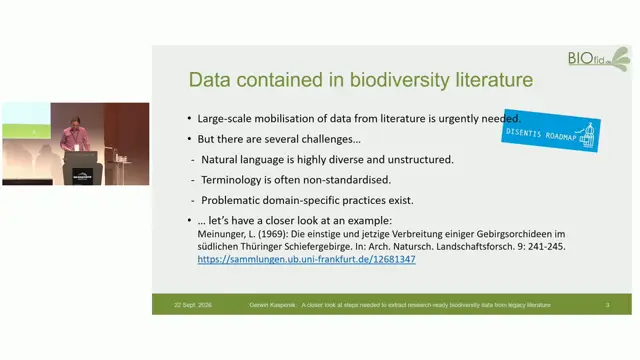
A closer look at steps needed to extract research-ready biodiversity data from legacy literature
Legacy literature data can only be unlocked by combining better OCR/NLP with taxonomic rigour that accounts for synonymy, shifting concepts, coreference and mixed languages.