
Developing and implementing a relational mineral taxonomy model in EMu for Museums Victoria's mineral collection
Oskar Lindenmayer · Rocks, Minerals, and Metadata: Integrating Earth Sciences into the TDWG Community
The short versionLinking catalogue records to shared, Mindat-populated mineral taxonomy records makes mineral identification data consistent and queryable.
What this was about
Oskar Lindenmayer described moving Museums Victoria's 57,000-specimen mineral collection (about 2,500 species, 131 type specimens) from classification stored locally in each EMu catalogue record to shared mineral taxonomy records in EMu's taxonomy module. The model adopts IMA hierarchy terms (species, subgroup, group, supergroup, plus other rank/value), keeps Dana class/code for legacy while adding Strunz-Mindat classes, handles solid-solution series such as wolframite via a multi-valued series field outside the hierarchy, and separates ideal formula and ideal elements. Catalogue records were linked to shell taxonomy records holding Mindat IDs before the new fields existed, then populated rapidly via the OpenMindat API, with about 150 non-standard records created manually.
Why it matters. Gives mineral collections a template for relational, standards-aligned classification data in a common CMS, reusing infrastructure built for biological taxonomy.
In the room
- Previously group and class were stored per catalogue record, producing inconsistencies across records for the same species.
- New taxonomy records (e.g. vanadinite) are shared by all catalogue records; some fields are mirrored back to the catalogue for querying.
- IMA 2009 hierarchy terms are used; other rank/value handles non-standard cases and the amphibole supergroup's fourth level.
- Dana classification has not been updated since 1997, so Strunz-Mindat class/code are recorded alongside it.
- A multi-valued series field lets a search for 'wolframite' return ferberite, hübnerite and series-level records without the whole wolframite group; series can span groups.
- EMu cannot render subscripts/superscripts, so a plain-text human-readable formula convention was adopted.
- Legacy data were copied into a locked field first; shell records with EMu IRN, Mindat ID and name allowed linking before implementation.
Notable moments
Transcript
Automatically generated captions can contain mistakes, especially in names and technical terms. Times are relative to the room recording.
Read the transcript ↓
Related talks.
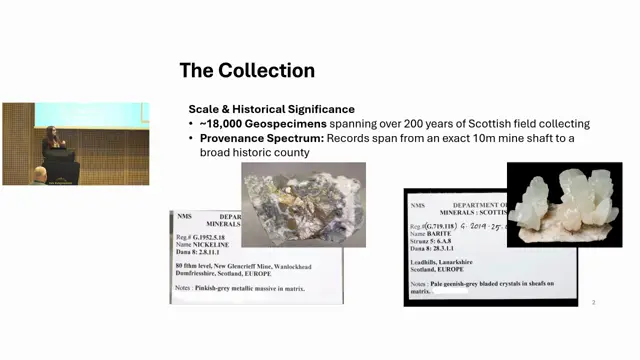
Improving geospecimen provenance and findability in the National Museums Scotland Scottish mineral collection
A scripted, reviewable workflow can quickly reconcile legacy mineral records and enrich them with Mindat coordinates, while giving data back to the community resource.
From Legacy Data to FAIR Workflows: Standardising Biodiversity Collections Using Specify
Standardised workflows, not just a new database, turned 11 differently managed collections into GBIF-ready data.
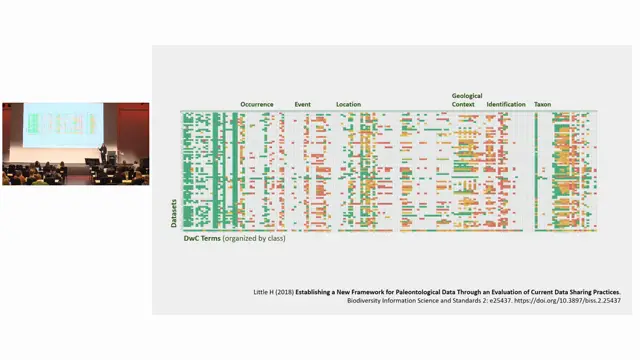
A framework for aligning collections data with the global data ecosystem from data creation to extension in the Smithsonian National Museum of Natural History Department of Paleobiology
Making paleo collections work in the global data ecosystem needs an iterative, full life-cycle framework, not one-off digitisation.