
Biodiversity data at your fingertips: open-access freshwater biodiversity information systems for South Africa and Africa
Helen Dallas · A consensus taxonomic reference for improved freshwater biodiversity data and knowledge
The short versionCo-designed, open and interoperable freshwater information systems like FBIS turn fragmented records into decision-ready information, and multi-tenancy helps keep them sustainable.
What this was about
Helen Dallas presented FBIS, the Freshwater Biodiversity Information System for South Africa, and its continental scale-up FBIS-Africa. Developed since 2017 through user-centred design for water resource and conservation managers, researchers, consultants and policymakers, FBIS holds over 14 million occurrence records across eight biodiversity modules and has 1,648 registered users. It uses the GBIF taxonomic backbone (with planned FADA integration), links to the IUCN Red List, offers spatial and temporal filters, spatial layers and standardised dashboards, and attaches citation metadata to every record. Separating the engine from the data enabled redeployment for other platforms via a multi-tenant model that improves sustainability.
Why it matters. It offers a proven, reusable platform model for regional biodiversity data systems in resource-constrained settings.
In the room
- Freshwater data are fragmented, inaccessible and poorly integrated, and thus underused in decision-making.
- FBIS development began in 2017 with a user-centred approach, designing backwards from end users' needs.
- FBIS holds over 14 million occurrence records, eight modules (fish, annelids, invertebrates, wetland and riparian plants, algae, wetland birds, water-dependent mammals and reptiles) and 1,648 registered users.
- Taxonomy uses the GBIF backbone; integration with FADA is planned; links to IUCN conservation status.
- Tools include spatial and temporal filters, spatial layers (catchments, ecoregions, protected areas), standardised dashboards, and downloadable graphs and data; every record carries citation metadata.
- Separating the engine from the data allowed redeployment for other, including non-freshwater, platforms and scale-up to FBIS-Africa.
- Multi-tenant model: independent governance and branding per tenant, shared costs, shared improvements and increased resilience.
Notable moments
Transcript
Automatically generated captions can contain mistakes, especially in names and technical terms. Times are relative to the room recording.
Read the transcript ↓
Related talks.
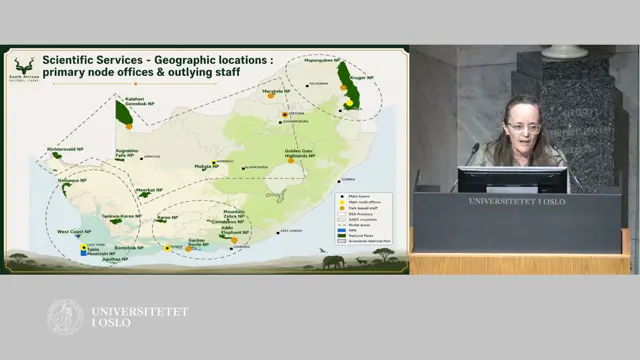
Using automation to consolidate biodiversity occurrence data in South African National Parks
Automating the harvest, integration and summary of biodiversity data lets park staff get evidence-based species lists and dashboards without laborious manual compilation.
The FIPbio data portal: towards an integrated freshwater biodiversity data ecosystem
FIPbio aims to make freshwater data publishing and analysis easier by combining FADA taxonomy, GBIF occurrences, site context, abiotic and remote-sensing data, and automated catchment annotation.
Catalogue of Life and Freshwater species data
Catalogue of Life pledges to model and expose freshwater designations within a year, fed by FADAtims and WoRMS, finally allowing freshwater species and occurrences to be identified via GBIF.