
Bionomia, Scholia, Wikidata and Zenodo: broadcasting biodiversity data contributions
Siobhan Leachman · Publishing and Communications Promoting Biodiversity, Natural History Collections, People, Data and Data Standards
The short versionLinking people, specimens, publications, datasets and collections through Wikidata and associated tools (Bionomia, Scholia, Expeditia, Zenodo) makes biodiversity contributions findable and creditable.
What this was about
Siobhan Leachman argued that Wikidata is 'the one ring to rule them all' for increasing the visibility of biodiversity data and the people and institutions behind it, because it is open (CC0), multilingual, linked and a hub for over 7,500 external identifiers. She showed how Bionomia attributes GBIF specimens to collectors and determiners and auto-archives their records to Zenodo with DataCite DOIs linked to ORCID, how Scholia visualises scholarly profiles and citation links (including to collections via 'uses'/'acknowledges' statements), and how Expeditia maps research expeditions. Zenodo communities were presented as a way to collate outreach and project outputs. Q&A covered privacy and researcher digital traces, and extending attribution to other roles such as conservators and taxon-name authors.
Why it matters. It offers practical, free routes for individuals and institutions to document the impact of collecting, identifying, publishing and collection use, which traditional metrics miss.
In the room
- Wikidata is a CC0, multilingual, human- and machine-readable knowledge base that anyone can edit and that search engines, AI applications and collection systems reuse.
- As an identifier hub Wikidata links to over 7,500 other websites, catalogues and databases, enabling round-tripping (e.g. BHL and the CETAF botany pilot pull people data from Wikidata).
- Bionomia links GBIF specimen records to Wikidata items (deceased) or ORCIDs (living) of collectors and determiners, generating profiles with maps, co-collector networks and citing literature, and its IDs are added back to Wikidata.
- Bionomia can automatically deposit versioned archives of a user's attributed specimens in Zenodo with a DataCite DOI, which can flow into ORCID profiles.
- Bionomia dataset profiles give institutions frictionless data packages to round-trip identifiers, spot data errors and find publications using their data.
- Scholia visualises Wikidata-sourced scholarly profiles; linking publications to collections or datasets via 'uses' or 'acknowledges' statements credits collections.
- Expeditia visualises research expeditions using Wikidata, GBIF, Bionomia and georeference data.
Notable moments
Transcript
Automatically generated captions can contain mistakes, especially in names and technical terms. Times are relative to the room recording.
Read the transcript ↓
Related talks.
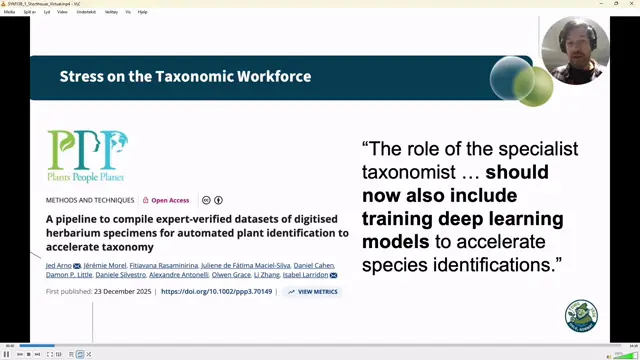
Open Digital Curation and Round-Tripping Biodiversity Data Enhancements Across Collection Infrastructures: Six Years and 50 Million Links in Bionomia
Round-tripping is much harder than expected, and data managers must fully populate identifiedBy so taxonomists' expertise is credited.
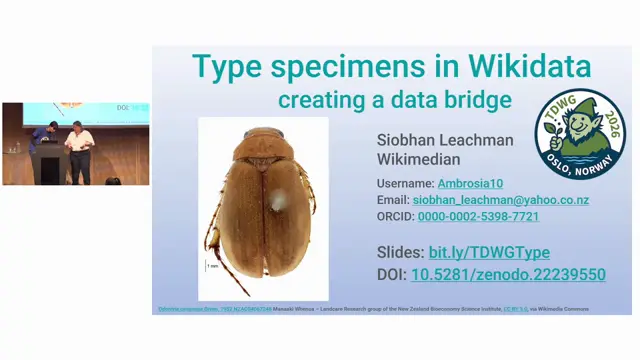
Type specimens in Wikidata
A consistent Wikidata type specimen model lets anyone link type specimens to collectors, publications, taxa and identifiers as a transparent finding aid.
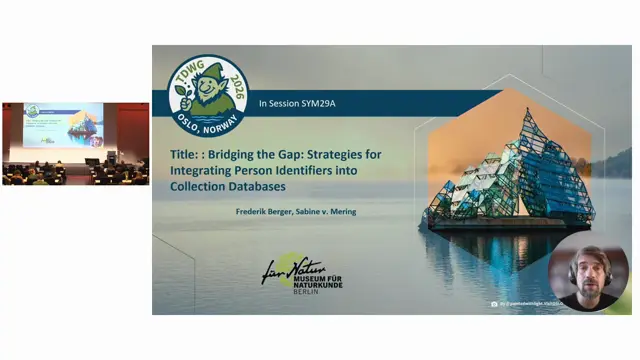
Bridging the Gap: Strategies for Integrating Person Identifiers into Collection Databases
Wikidata's community-built person data can be used to pre-structure candidate matches, but expert judgement and institutional priorities remain essential for identifying collectors.