
TDWG 2026 Unconference: pitches, topic voting and breakout report-backs
Javier Molina, Nicky Nicolson, Deb Paul, Esteban Marentes, Maarten Trekels, Quentin Groom, Sam Leeflang, Yasin Bakış, Siobhan Leachman, Rukaya Johaadien · TDWG 2026 Unconference
The short versionThe Unconference showed the community's priorities (controlled vocabularies, AI readiness, project sustainability, Wikidata, Darwin Core data packages) and started several follow-up groups.
What this was about
Organisers explained the format. Eleven proposers gave 90-second pitches: AI for natural history collections (CETAF), botanical legacies and access and benefit sharing, SPNHC-TDWG ties, causal modelling in ecology, controlled vocabularies, trait standards, river basin naming, what makes data AI-ready, Wikidata, project closure ('Closing Time'), and Darwin Core data packages and structured data extraction. After in-room and Zoom voting (interrupted by a Zoom outage), six groups met: controlled vocabularies (31 votes), Closing Time (22), AI readiness (20), Wikidata, AI for collections and Darwin Core data packages. Report-backs included plans for a controlled-vocabularies interest group, a working definition of AI readiness, Wikidata people-identifier issues, a global CETAF AI living document, and GBIF-centred conclusions on Darwin Core data packages.
Why it matters. It records community-driven agendas and commitments (a new interest group, an AI-readiness definition, a living AI guidelines document) that may shape future TDWG work.
In the room
- Pitches: Maarten (CETAF ISTC AI and robotics group) proposed a living document of AI use cases and guidelines for collections.
- Quentin proposed discussing access and benefit sharing for digitised herbarium legacies (Nagoya Protocol), to improve a COST Action proposal due in October.
- Deb Paul proposed making the SPNHC-TDWG memorandum of understanding more formal, with reciprocal activities each year.
- Other pitches: causal modelling in ecology (EcoWeaver), discoverability of controlled vocabularies, trait data standardisation from an aquatic trait thesaurus, standardised river basin naming, defining AI readiness (new IQ-AIR task group), Wikidata for biodiversity, project closure and succession planning, Darwin Core data packages (ChatIPT experiences) and comparing structured-data extraction methods.
- Votes: controlled vocabularies 31, Closing Time 22, AI-ready 20, Wikidata ~18, AI for collections 18, Darwin Core data packages 17 (14 + 3 online), botanical legacies 14, causal modelling 13, traits 12 + 1, SPNHC 10, river basins 3, extraction comparison 3.
- Controlled vocabularies: the data quality group already listed 100+ active vocabularies; mapping tools exist; GBIF's vocabulary concepts could be improved; an interest group is being formed.
- Closing Time: covered adopting physical and digital collections, supporting affected people, sudden disasters such as hacking, and the lack of up-to-date job descriptions and exit interviews.
Notable moments
Transcript
Automatically generated captions can contain mistakes, especially in names and technical terms. Times are relative to the room recording.
Read the transcript ↓
Related talks.
Address from the TDWG Chair: highlights of the year and TDWG at a crossroads
TDWG has had a productive year, but a growing, more diverse community and the rise of AI put it at a crossroads that needs more volunteers, better documentation and more sustainable maintenance and funding.
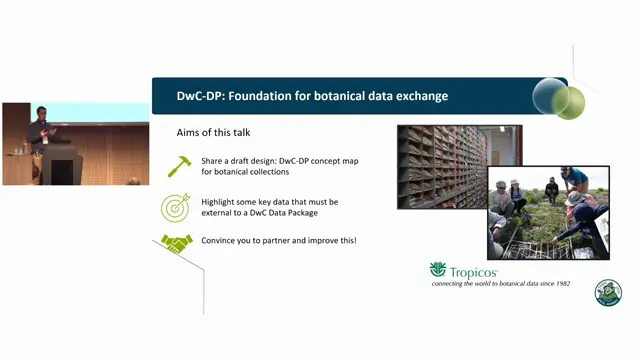
Machine-Ready Botanical Data: Mapping Integrated Collections and Traits with Darwin Core Data Package
Darwin Core Data Package can serve as a semantic integration layer for a botanical garden's diverse collections and trait data, and MBG's draft mapping is offered for community refinement.
Panel discussion: From Mobilizing Data to AI-Ready Knowledge
AI-readiness is purpose-dependent, and the hardest remaining problems are social: trust, attribution, governance and data sovereignty, where ontologies and knowledge graphs offer some control and explainability.