
Bridging eLTER Data Reporting Format: enabling interoperable biodiversity and ecological data publication across research infrastructures
Alessandro Oggioni · Semantic Interoperability and Standards Infrastructure
The short versioneLTER is aligning its CSV-based data reporting format with Darwin Core and Frictionless data packages to make long-term ecological data more FAIR.
What this was about
Alessandro Oggioni presents the eLTER Research Infrastructure, a pan-European network of long-term ecological sites, and its Data Reporting Format: a zip of CSV tables (method, reference, station, event, sample, licence and data) described by a specification on Zenodo. To improve interoperability, eLTER built a vocabulary of its template terms mapped to Darwin Core where possible and an R function that converts reports into Frictionless data packages. In Q&A he said Darwin Core Data Package largely suffices, but the strong link between data and monitoring sites/facilities is missing.
Why it matters. Bridging long-term ecological monitoring data with biodiversity standards enables cross-infrastructure reuse.
In the room
- eLTER RI studies structure, processes and functions of terrestrial, freshwater, coastal and transitional ecosystems; entered the ESFRI roadmap about 10 years ago.
- Sites collect ecosystem, chemical, soil, atmospheric and biological parameters.
- Data Reporting Format: relational-like CSV tables zipped together; specification published on Zenodo.
- Vocabulary of template terms with Darwin Core matches and URIs where available.
- R function generates Frictionless data packages from eLTER reports.
- Future: automated publication workflows.
Notable moments
Transcript
Automatically generated captions can contain mistakes, especially in names and technical terms. Times are relative to the room recording.
Read the transcript ↓
Related talks.
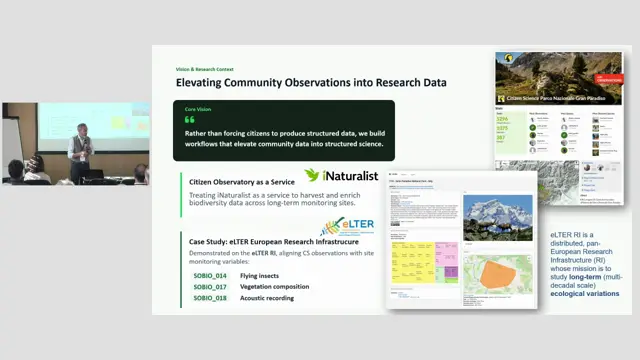
From citizen observations to long-term ecological knowledge: integrating iNaturalist records into LTER framework through automated enrichment
Rather than forcing citizens to produce structured data, automated enrichment elevates iNaturalist records into research-ready data for eLTER sites.
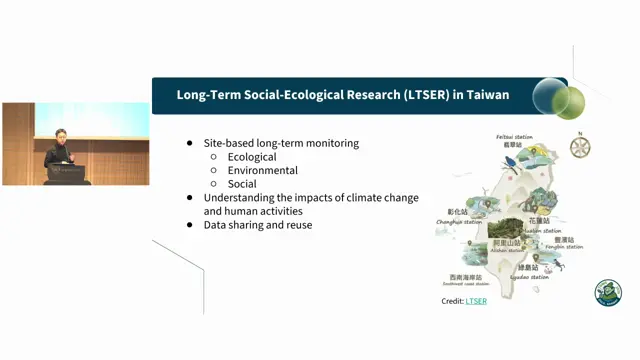
Building a Living Publication Workflow for Long-Term Social-Ecological Monitoring Data: The Taiwan LTSER Experience
Embedding Darwin Core alignment as automated checkpoints in a repository-based pipeline keeps continuously updated monitoring data flowing to GBIF.
From NetCDF to Web Maps: Building an Open-Source Web GIS for Biodiversity Data Cubes
A simple open-source stack of NetCDF, THREDDS/ncWMS and vanilla JavaScript makes multidimensional biodiversity data cubes browsable and analysable in the browser.