
Digitize, Standardize, Mobilize: Wildlife Biodiversity Biobanking with Specify
Kim Labuschagne · Meeting Biodiversity Data Standards Using Specify Software
The short versionSpecify's hierarchical trees and attachments turned a fragmented wildlife biobank into a traceable extended-specimen data system.
What this was about
Kim Labuschagne presented the SANBI Wildlife Biobank, which holds samples and e-vouchers rather than whole specimens. It has over 250,000 samples from more than 110,000 animals in 46 countries, covering about 1,900 species including many threatened ones. She explained why an extended-specimen data model is needed to link samples, derivatives, permits, storage history, molecular data and publications, and how implementing Specify around 2013 replaced disconnected spreadsheets and records. Key features are the taxon, storage (bank→freezer→rack→box→position) and geography trees, attachments for permits and chain-of-custody photos, and customisable workflows.
Why it matters. Biobanks are growing conservation and genomics infrastructure, and their value depends on tracing every aliquot, permit and derived dataset back to the individual animal.
In the room
- The biobank was established in 1994 and holds over 250,000 samples from more than 110,000 individual animals from 46 countries, spanning 14 phyla and nearly 1,900 species.
- Many holdings are threatened on the IUCN Red List, including the extinct western black rhino.
- 79 different sample types are stored from room temperature down to -196 °C. Every freezer-to-freezer move is a QC point that must be recorded.
- The data model has moved from 'tissue sample + catalogue number' to an extended specimen with voucher, field metadata, permits, storage history, DNA extraction, genome sequence, disease screening and publications.
- Specify was implemented around 2013, with support from SAIAB, to replace disconnected systems.
- The storage tree locates samples down to position in a box. Catalogue numbers plus barcodes prevent searching through hundreds of boxes.
- Attachments hold permits (including CITES and disease regulations), data sheets and chain-of-custody photographs.
Notable moments
Transcript
Automatically generated captions can contain mistakes, especially in names and technical terms. Times are relative to the room recording.
Read the transcript ↓
Related talks.
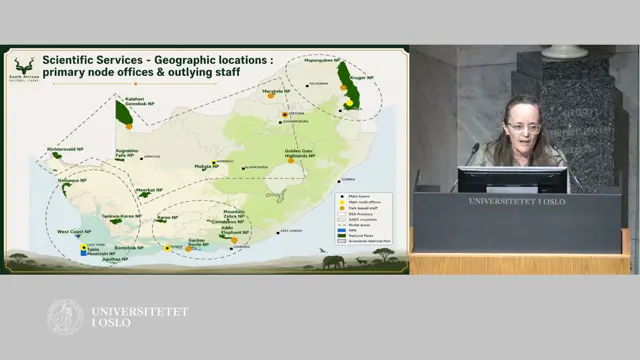
Using automation to consolidate biodiversity occurrence data in South African National Parks
Automating the harvest, integration and summary of biodiversity data lets park staff get evidence-based species lists and dashboards without laborious manual compilation.
From Legacy Data to FAIR Workflows: Standardising Biodiversity Collections Using Specify
Standardised workflows, not just a new database, turned 11 differently managed collections into GBIF-ready data.
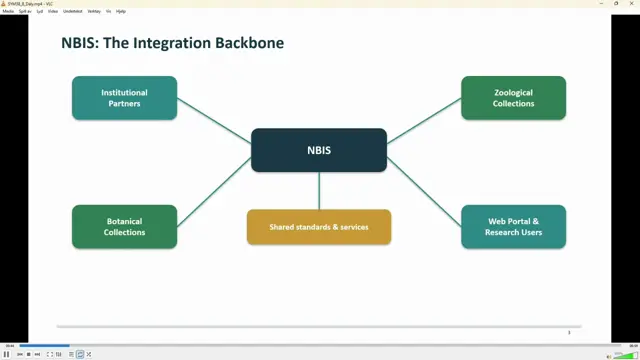
Architecting the National Biodiversity Information System: Standards-Driven Workflows for South Africa’s Botanical and Zoological Data
SANBI sustains NBIS through a statutory mandate plus a roadmap of diversified funding, partnerships and demonstrated return on investment.