
Bridging domains: how SESAR supports Earth and biodiversity digital extended specimens
Andrea Thomer · Rocks, Minerals, and Metadata: Integrating Earth Sciences into the TDWG Community
The short versionPersistent sample identifiers plus linked metadata propagated to DataCite let samples be connected to their derived research products across Earth and biodiversity domains.
What this was about
Andrea Thomer introduced SESAR (System for Earth and Extraterrestrial Sample Registration), a nearly 20-year-old registry at Columbia University that mints IGSNs (now DataCite DOIs) for physical samples and holds over five million samples from more than 1,800 users, including a growing number of biodiversity records. She previewed a major migration under way that week: a redesigned search portal, sample landing pages with maps and sample 'family' links, an improved Workbench, and adoption of an application profile of the iSamples Earth and environmental material vocabulary (thousands rather than hundreds of terms). SESAR supports digital extended specimens by storing IGSNs, other identifiers and semantically rich links to related resources that propagate to DataCite Commons, and is developing a Darwin Core crosswalk and profiles for other communities.
Why it matters. Shows how a mature geoscience PID infrastructure can support biodiversity collections and the digital extended specimen vision.
In the room
- SESAR was founded in 2004 by Kerstin Lehnert and fully operational since 2009; it is the birthplace of the IGSN.
- IGSN (International Generic Sample Number) is now effectively a DOI managed by DataCite, giving unambiguous links from papers and datasets to samples.
- The new system has a redesigned search portal, landing pages with maps and links to parent/sibling samples, and an improved Workbench with registration, usage metrics and team permissions.
- SESAR metadata stores the IGSN, local catalogue/field numbers and explicit semantic links to related digital resources, which are propagated to DataCite Commons for network traversal and metrics.
- Adopts a lightly edited application profile of the iSamples Earth and environmental science material vocabulary (by Steve Richard).
- The new architecture eases extension vocabularies; a SESAR-to-Darwin Core crosswalk and Darwin Core sample profile are in development, with Illinois Natural History Survey herpetology as a test case.
- Planned profiles for marine/lacustrine core repositories, astromaterials/meteorites and tephra.
Notable moments
Transcript
Automatically generated captions can contain mistakes, especially in names and technical terms. Times are relative to the room recording.
Read the transcript ↓
Related talks.
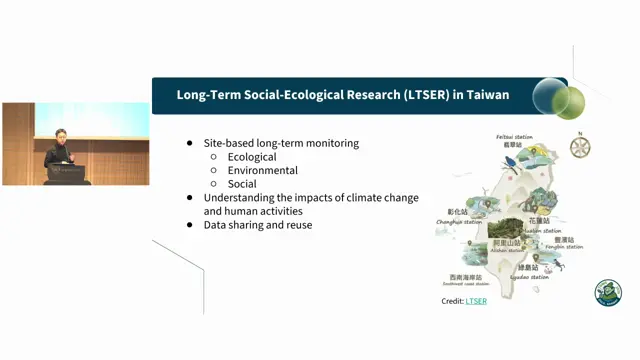
Building a Living Publication Workflow for Long-Term Social-Ecological Monitoring Data: The Taiwan LTSER Experience
Embedding Darwin Core alignment as automated checkpoints in a repository-based pipeline keeps continuously updated monitoring data flowing to GBIF.
Closing Gaps in Specimen Metadata: A Collaborative Annotation and Feedback Platform for Natural History Collections
A national collaborative annotation platform with AI-assisted transcription can close metadata gaps across many Taiwanese collections.
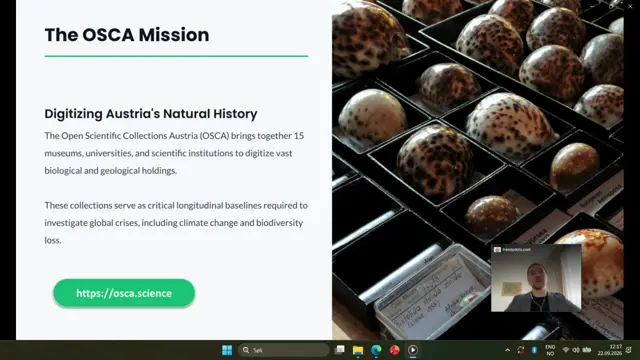
How Darwin Core enables harmonizing Biodiversity Data via the OSCA Consortium
A shared Darwin Core-based cloud pipeline lets 15 Austrian institutions of very different IT capacity publish harmonised specimen data.