
Extending Specify 7 for geological collections (GeoSpecify)
Theresa Miller · Rocks, Minerals, and Metadata: Integrating Earth Sciences into the TDWG Community
The short versionGeoSpecify brings geology into the same Specify data model as biological collections, with purpose-built age, stratigraphy and composite-object features.
What this was about
Theresa Miller presented GeoSpecify, the SwissCollNet-funded collaboration (Natural History Museum Bern, Specify Collections Consortium, Ben Norton) that extended the existing Specify 7 data model for geology rather than building a separate system. After requirements gathering with Swiss museums and an advisory committee, Specify gained an improved chronostratigraphy tree with start/end ages and biostratigraphy flags, a tectonic unit tree, an extended Geologic Context table, one-to-many relative and absolute age tables, and an 'extended age query' that searches all age fields by name or numeric range with strict or non-strict matching. Collection object types, discipline default forms, collection object groups (discrete, consolidated, drill core) and components allow mixed rock, mineral and fossil collections in one system, with Darwin Core Archive export planned to include the mineralogy extension.
Why it matters. Institutions with mixed biological, paleontological and geological holdings can manage them in one standards-aligned system and publish geology data via Darwin Core.
In the room
- Project led by Beda Hofmann (NHM Bern), James Beach (Specify) and Ben Norton, funded via the Swiss Academy of Sciences' SwissCollNet; phase 1 (from 2023) built a conceptual model and classification, phase 2 defined requirements and implementation.
- Requirements came from four Swiss collections (Bern, Basel, Geneva, Lausanne), a GeoSpecify advisory committee and an on-site requirements trip; needs included warnings for heavy or toxic specimens.
- Chronostratigraphy tree shows start/end dates, links to the International Chronostratigraphic Chart, stays ordered by age and can flag biostratigraphy nodes.
- Lithostratigraphy and a new Tectonic Unit tree are populated locally because terms vary by region.
- Geologic Context links to all stratigraphic trees and supports start and end chronostratigraphic periods; relative and absolute ages are one-to-many (e.g. deposition and metamorphism ages).
- Extended age query searches geologic context, relative and absolute ages together, converting period names to numeric ranges and supporting strict/non-strict range matching.
- Collection Object Types let one collection hold minerals, rocks and fossils with different trees, forms and numbering; Collection Object Groups (discrete, consolidated, drill core) and components capture composite specimens.
Notable moments
Transcript
Automatically generated captions can contain mistakes, especially in names and technical terms. Times are relative to the room recording.
Read the transcript ↓
Related talks.
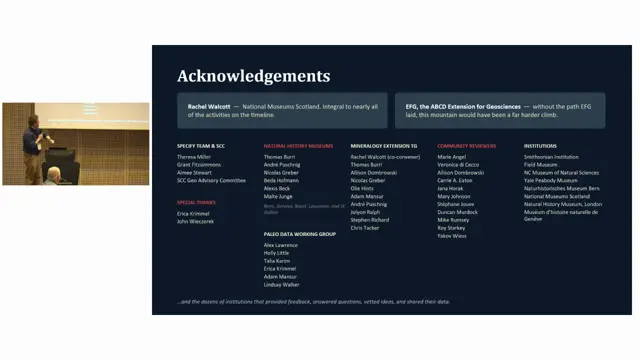
Session discussion: mineralogy extension and MIDS geology rules
Geology collections now have concrete standards moments to engage with: the mineralogy extension ratification and the MIDS public review.
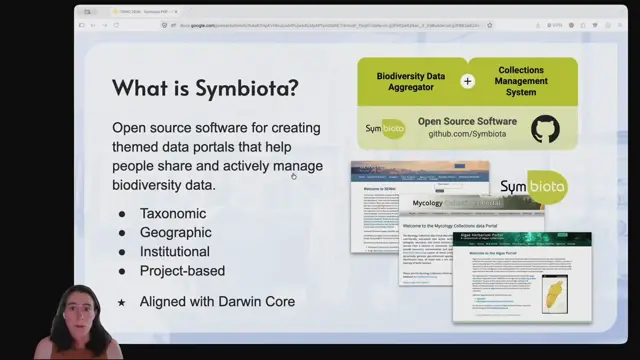
Mobilizing rich, interoperable, and secure fossil data from underserved collections using Symbiota
Targeted Symbiota enhancements around geological context, taxonomy and relationships make a low-barrier CMS viable for under-resourced fossil collections.
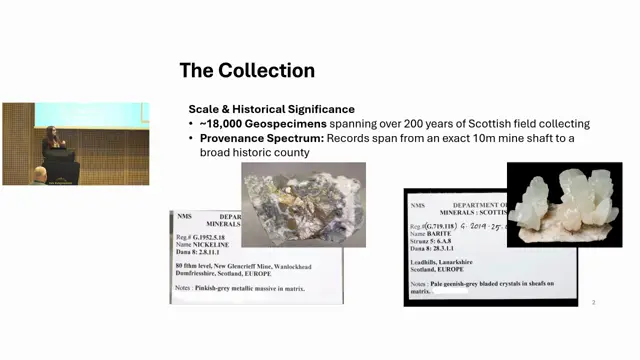
Improving geospecimen provenance and findability in the National Museums Scotland Scottish mineral collection
A scripted, reviewable workflow can quickly reconcile legacy mineral records and enrich them with Mindat coordinates, while giving data back to the community resource.