
Modernizing Brazil's taxonomic backbone: how ChecklistBank supports biodiversity and genetic heritage systems
Clara Baringo Fonseca · National & Global Taxonomic Backbones
The short versionChecklistBank lets a small national node assemble one consistent taxonomic backbone for legal, portal and permitting systems.
What this was about
Clara Baringo Fonseca described how GBIF Brazil uses ChecklistBank to build a single taxonomy for three national systems: the legally mandated genetic heritage and traditional knowledge system (SisGen), the national biodiversity portal and the protected-area research permit system. The monthly-updated Flora and Funga of Brazil (since 2010, 700+ specialists) and the Taxonomic Catalogue of the Brazilian Fauna (since 2015, 800+ specialists) are cleaned, merged with invasive species, Catalogue of Life microorganisms and GBIF fungi in ChecklistBank projects, and exported as Darwin Core Archives, some with and some without microorganisms. The taxonomy drives processing in the Living Atlas Brazil portal, versioned republication with DOIs in the IPT, and data-gap maps relevant to Global Biodiversity Framework targets 20 and 21.
Why it matters. Shows how a megadiverse country operationalises national checklists for policy and legal compliance, and the workflow gaps between species description and national lists.
In the room
- Brazil has about 120,000 animal and 67,000 plant species; national catalogues are updated monthly by hundreds of taxonomists.
- A 10-year plan aims to create a Brazilian Catalogue of Life merging flora, fauna, fossils and microorganisms.
- Three national systems (genetic heritage/traditional knowledge, national portal, protected-area permits) must share the same taxonomy.
- ChecklistBank is used to clean duplicates and mis-mapped Darwin Core fields, merge lists, and add Catalogue of Life microorganisms and GBIF fungi.
- Living Atlas Brazil processes occurrence taxonomy against the official backbone, showing original vs processed names.
- Versions are republished in the IPT with DOIs, not sent onward to avoid duplication.
- Maps of taxonomic/occurrence knowledge show major gaps in marine areas and Amazonia.
Notable moments
Transcript
Automatically generated captions can contain mistakes, especially in names and technical terms. Times are relative to the room recording.
Read the transcript ↓
Related talks.
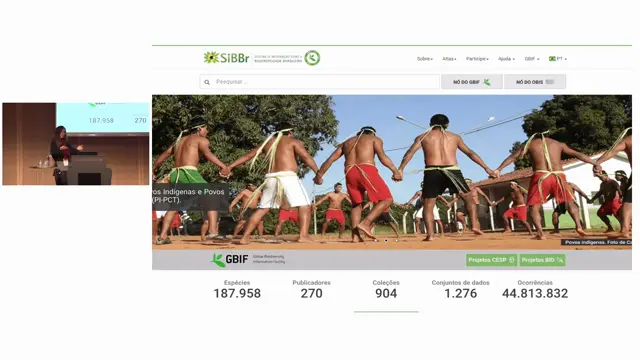
Toward RASD Implementation in Brazil: Integrating Conservation, Open Data, and Traditional Knowledge Safeguards
Protecting traditional knowledge requires community-controlled, attribute-level and semi-restricted access, not just hiding species locations.
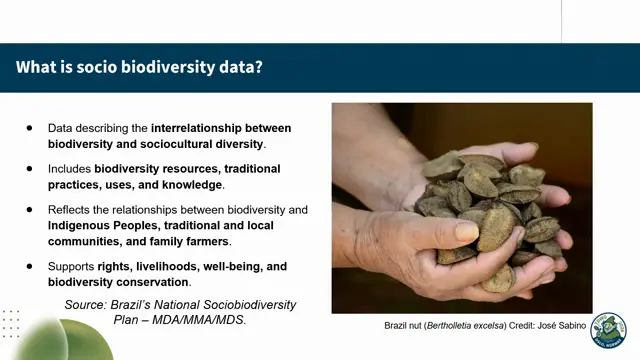
Extending Darwin Core to Represent Sociobiodiversity and Traditional Knowledge
Representing traditional knowledge in biodiversity standards needs new terms, knowledge-centred (not species-centred) models, and careful governance of who holds and publishes the data.
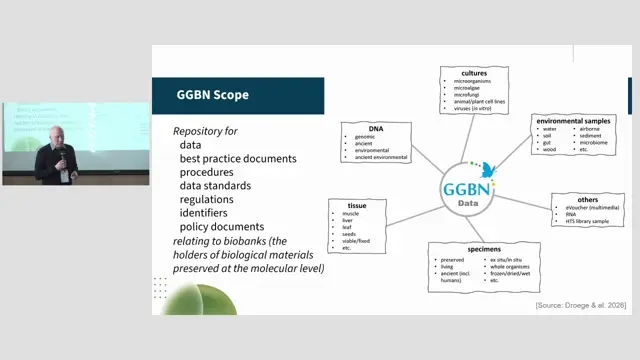
Rebuilding core functionalities of the GGBN system: taxonomic alignment with international research infrastructures
GGBN is rebuilding transparent automated name parsing and matching on GBIF parsing and ChecklistBank/Catalogue of Life XR to improve sample discovery.