
Automated Landmark Detection for Scalable Morphometric Data Extraction from Digitized Fish Collections
Bahadir Altintas · Large Language Models for Biodiversity Data Discovery, Integration, and Curation. AI applications, integration, and validation
The short versionA lightweight dlib shape-regression model can automate most fish landmarking from museum images, but inner landmarks and variable specimen poses remain hard.
What this was about
Bahadir Altintas presented a dlib-based machine-learning workflow for automatically placing 28 anatomical landmarks on images of Notropis minnows from museum collections. Fish are detected and cropped, landmarks are predicted, and predictions are compared with manual StereoMorph annotations. On 250 test images accuracy was 95% at a 0.02 error threshold and 85.3% at 0.01. Outline landmarks and the eye were most accurate; inner landmarks and curved, folded or dorsal-view specimens were hardest. Accuracy varied by species from about 66% to near 100%.
Why it matters. Manual landmarking limits morphometric studies. Automated landmarks could make digitised collection images an AI-ready source for large-scale shape analyses.
In the room
- Dataset: 48 Notropis species, 28 landmarks from the literature, 217 training and 250 test images.
- Manual annotation with the StereoMorph R package produced coordinates for training.
- dlib was chosen for being fast, lightweight, CPU-efficient and extendable from face-landmark models; it uses regression to predict landmark positions.
- Pipeline: detect the fish in the museum image, crop, predict landmarks.
- Accuracy by Euclidean distance: 95% at 0.02 threshold, 85.3% at 0.01.
- Outline landmarks were more accurate than inner-body ones; the eye was very accurate, perhaps because of its distinctive shape.
- Per-species accuracy ranged from ~100% (N. chalybaeus) to 65.97% (N. buchanani), about 34% variation.
Notable moments
Transcript
Automatically generated captions can contain mistakes, especially in names and technical terms. Times are relative to the room recording.
Read the transcript ↓
Related talks.
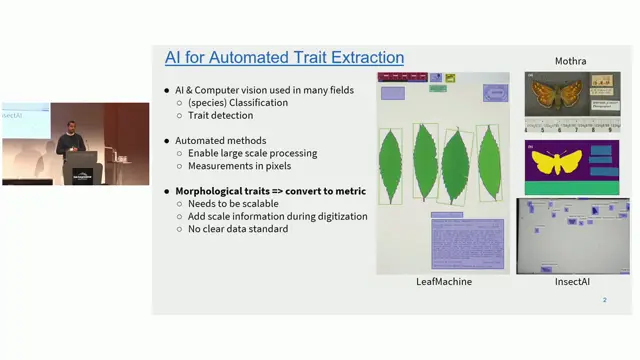
Towards Scalable Trait Measurements from Digitized Specimens
Matching rulers to an annotated reference set lets specimen images be calibrated to real-world units with under 1% error in 96% of cases.
Toward Quantitative AI-Readiness Metrics for Biodiversity Data Infrastructures
AI readiness should be a task-specific, measurable profile rather than a single score, and current biodiversity standards lack most of the terms needed to describe it.
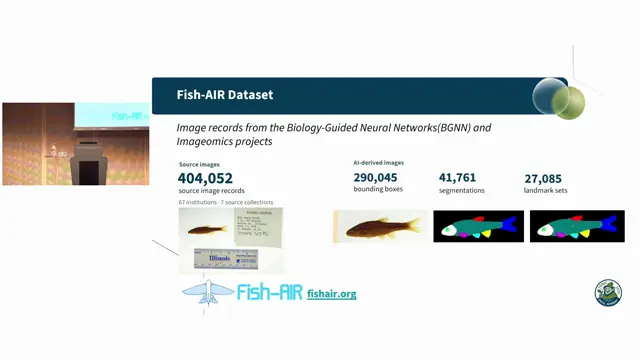
Provenance, Lineage, and Auditability in AI-Driven Biodiversity Image Workflows
Two persistent-identifier links per derived image, parent and batch, are enough to preserve auditable lineage and pipeline context for AI-processed biodiversity images, even outside the repository.