
Cross-Modal Coordination for Biodiversity Monitoring at Scale: Lessons from SmartWilds
Jenna Kline · AI for Biodiversity Data
The short versionCoordinating multiple sensor modalities with AI at the far edge, informed by synchronised multimodal datasets like SmartWilds, can scale and adapt biodiversity monitoring.
What this was about
Jenna Kline, a postdoc at MIT, presented her PhD work reframing ecological sensing as an adaptive edge-systems problem in which AI closes the sensing loop. She first described autonomous drone systems for tracking herds that redefine the target as the herd, add behaviour-adaptive flight to reduce disturbance, and adapt paths to capture views needed for individual identification (tested in Ohio and Kenya). She then argued for cross-modal coordination among drones, camera traps, acoustic monitors, citizen science and GPS, presenting the SmartWilds dataset from a summer-long campaign at The Wilds safari park in Ohio: nearly 400,000 occurrences across five modalities with metadata enabling temporal and spatial cross-referencing against a known census. Synchronised traces from such datasets can inform provisioning decisions (models, hardware, sensor configuration, thresholds) before expensive field trials.
Why it matters. Moves monitoring from collect-then-analyse pipelines toward real-time adaptive sensing, and shows how multimodal benchmark datasets can de-risk the design of field systems.
In the room
- Traditional workflows separate sensing, inference and analysis, preventing real-time adjustment and delaying insights.
- 'Far edge' means both remote field sites and constrained commodity hardware with latency and connectivity limits.
- Autonomous drone work: herd tracking, behaviour-adaptive flight, and surface-of-interest-aware paths (e.g. elephant ears, zebra/giraffe flanks for individual ID).
- AI in the loop increased the yield of usable data in field tests in Ohio and Kenya.
- SmartWilds: 200-acre pasture with known census of milu deer, takin and Przewalski's horses; ~400,000 occurrences across five modalities.
- Cross-modal triggers: a camera trap alarm could launch a drone; an acoustic event could activate camera traps; a citizen science observation could trigger other sensors.
- Biodiversity datasets must be usable by robotics and AI research communities.
Notable moments
Transcript
Automatically generated captions can contain mistakes, especially in names and technical terms. Times are relative to the room recording.
Read the transcript ↓
Related talks.
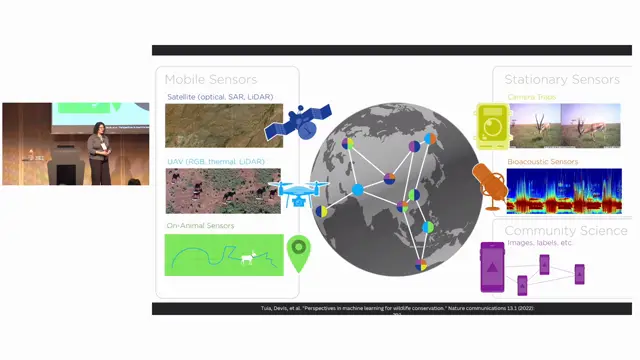
Digital Twins as System-Optimization Tools: Provisioning Edge and Cloud Infrastructure for Biodiversity Monitoring at Scale
Digital twins should close the sim-to-real loop for the sensor systems too, letting teams plan where and how to deploy multimodal monitoring before going into the field.
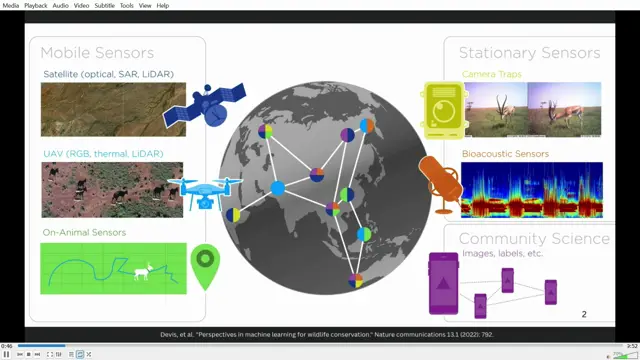
FAIR² Drones: An AI-Ready Standard for Cross-Domain Wildlife Drone Dataset
A shared dataset card that captures ecological, robotic and computer vision metadata makes costly drone datasets reusable across disciplines.
Scalable Edge AI for Real-Time Biodiversity Monitoring: tracking invasive plant species in roadside imagery
Distilling a tiling-based plant identifier into a single ConvNeXt model makes high-resolution roadside invasive-species monitoring fast, cheap and more accurate.